



Introduction
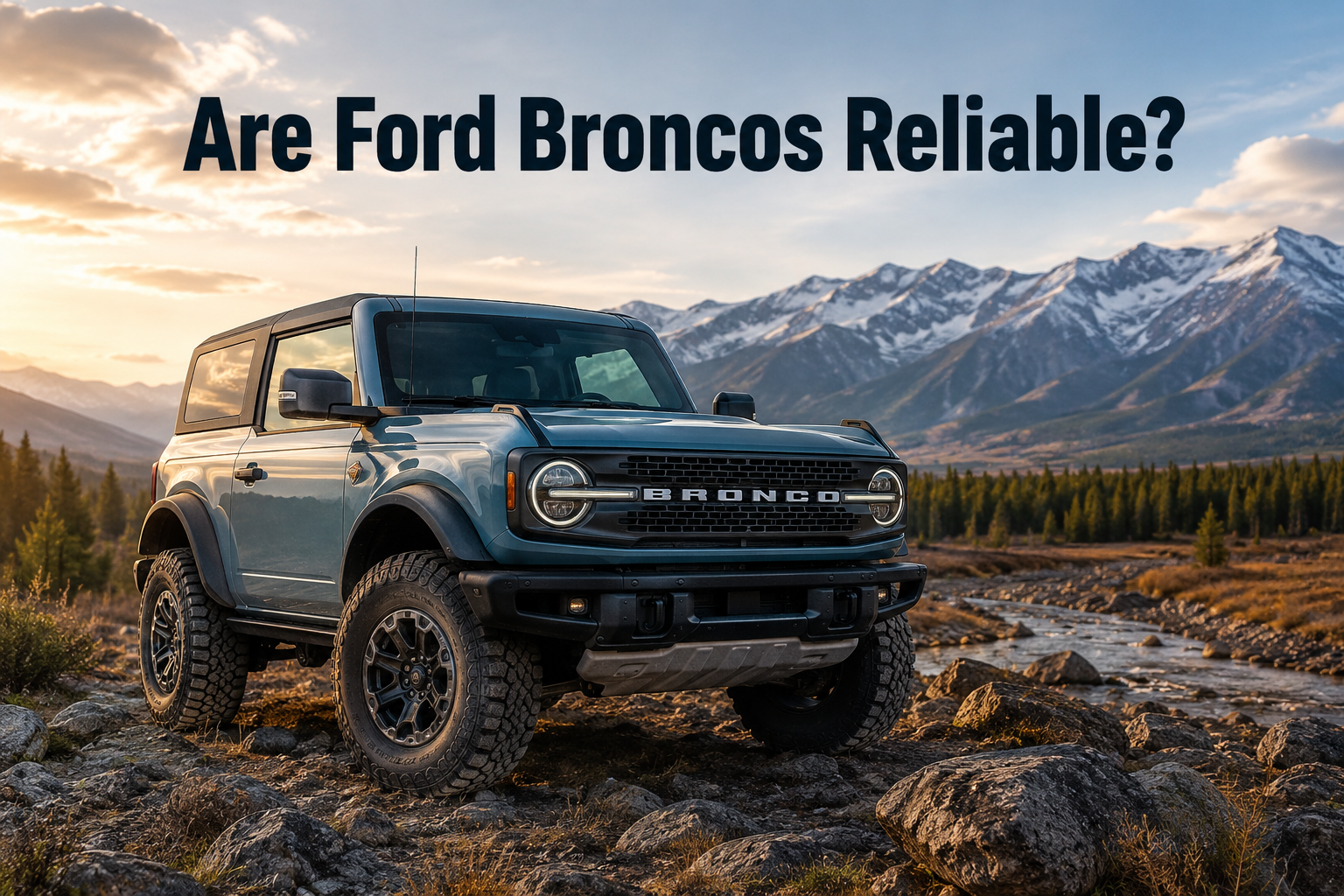
If you have been shopping for a rugged, retro-styled SUV, chances are the Ford Bronco has landed on your shortlist. It looks tough, it drives well off the beaten path, and it brings back a name that older buyers remember fondly from decades past. But before signing on the dotted line, most shoppers ask the same question: are Ford Broncos reliable enough to trust for daily driving and long road trips?
The honest answer is that it depends on which year you are looking at, how the vehicle has been maintained, and what kind of driving you plan to do with it. Since its relaunch, the Bronco has earned a reputation as an exciting and capable off-roader, but it has also picked up a fair number of recalls and owner complaints along the way. This guide walks through everything you need to know, from year-by-year reliability scores to the most common mechanical issues, so you can make an informed decision.
Ford Bronco Reliability at a Glance
Generally speaking, the Ford Bronco sits in the “average to below average” range when it comes to mechanical dependability, based on data gathered from owner complaints, recall counts, and consumer satisfaction surveys. It is not the least reliable SUV on the market, but it is also not a vehicle known for going hundreds of thousands of miles without a hiccup, at least not yet, since the nameplate is still relatively young in its current generation.
What makes the Bronco an interesting case is the gap between raw reliability data and how much owners actually enjoy the vehicle. Even when surveys point to a higher-than-average number of complaints, satisfaction scores from real owners tend to stay strong. People who buy a Bronco usually know what they are getting into, an adventure vehicle first and a completely trouble-free commuter second.
Here is a simplified snapshot of how the Bronco compares against its most direct rival, the Jeep Wrangler, in terms of general reliability perception:
| Category | Ford Bronco | Jeep Wrangler |
|---|---|---|
| Reliability Reputation | Average to below average | Below average |
| Owner Satisfaction | High | High |
| Recall Frequency | Above average | Above average |
| Resale Value | Strong | Strong |
| Off-Road Capability | Excellent | Excellent |
Both vehicles trade some day-to-day dependability for serious off-road credibility, which is a common pattern among body-on-frame SUVs built for trail use rather than pure commuting comfort.
Reliability by Model Year
Not every Bronco is built the same, and reliability has shifted noticeably from one model year to the next. Early production years tend to carry more issues simply because that is when manufacturers are still working out kinks in a brand-new platform.
2021 Bronco
The first model year after the Bronco’s relaunch was, unsurprisingly, the roughest. Production delays pushed many 2021 models into buyers’ hands later than expected, and once on the road, owners reported a noticeable number of electrical gremlins. Infotainment glitches, sensor malfunctions, and wiring-related recalls were common complaints. If dependability is your top priority, this is generally considered the year to avoid.
2022 Bronco
The 2022 model year carried over many of the same growing pains as 2021. Recall numbers remained high, and electrical system issues continued to be the most frequently cited complaint category. Some mechanical issues related to the drivetrain also surfaced during this period.
2023 Bronco
By 2023, Ford had made some improvements, though the model year still saw a large number of recalls, including issues tied to the windshield wiper system and continued electrical concerns. It represents a middle ground, better than the launch years but still not the smoothest ownership experience.
2024 Bronco
The 2024 Bronco showed meaningful progress, though it was also the year of one of the more serious recalls in the model’s history, an intake valve failure affecting engines that, in worst-case scenarios, required a full engine replacement. Despite this, overall complaint volume trended downward compared to earlier years, and owner satisfaction remained high.
2025 Bronco
Currently regarded as the most dependable Bronco to date, the 2025 model year benefits from several years of engineering refinement. Recall counts and owner complaints dropped noticeably compared to the 2021 through 2023 lineup, suggesting Ford has been actively addressing the platform’s early weaknesses.
Best and Worst Years to Buy
If you are shopping used and reliability is a major factor in your decision, here is a quick reference guide:
| Model Year | General Reliability | Recommendation |
|---|---|---|
| 2021 | Weakest | Avoid if possible |
| 2022 | Weak | Approach with caution |
| 2023 | Moderate | Acceptable with inspection |
| 2024 | Improved | Solid choice |
| 2025 | Best so far | Strong choice |
Common Problems and Known Issues
Understanding the specific problem areas can help you know what to watch for during a test drive, pre-purchase inspection, or ownership experience.
Electrical system issues have been the most persistent complaint across nearly every model year. These range from minor annoyances, like infotainment freezing, to more serious concerns involving warning lights, sensor errors, and battery drain.
Powertrain and engine problems have also appeared, most notably the intake valve issue that affected a large batch of Broncos equipped with certain EcoBoost engines. This is one of the more expensive problems to face, since it can require significant engine work.
Suspension and damper issues, particularly related to the Bronco’s off-road-focused HOSS suspension system, have shown up in the form of corroded rear dampers that can fail or detach over time.
Rearview camera glitches have led to multiple recalls, with software errors occasionally causing the display to freeze, go blank, or fail to update correctly during reversing.
Fuel system concerns have affected certain model years, including reports of fuel injectors cracking and leaking, which raises fire risk if left unaddressed.
Interior and build quality complaints are less severe but still worth noting, things like rattling trim pieces, wind noise at highway speeds, and general cabin refinement that trails behind more traditional, non-off-road SUVs.
Major Recalls Explained
Recalls are a normal part of owning any vehicle, but the Bronco has had more than its share since launch. Below is a breakdown of some of the most significant ones.
The intake valve failure recall stands out as the most serious, since it affected engines that could require complete replacement in severe cases. This recall touched a large number of vehicles equipped with certain turbocharged EcoBoost engines, not just the Bronco alone.
A separate recall addressed corrosion in the rear damper reservoirs, part of the Bronco’s advanced off-road suspension setup. Left unresolved, the affected component could detach entirely while driving.
Two additional recalls focused on rearview camera software, where a display error could leave the camera image frozen or blank during reversing, a safety concern for visibility.
Other recalls over the years have included issues with front suspension ball joints, fuel pump bolts, and even a cracked engine block heater that created a fire risk from coolant leaking near electrical components.
If you currently own a Bronco or are buying a used one, it is worth checking the vehicle identification number against the National Highway Traffic Safety Administration’s recall database to confirm whether any outstanding recalls have not yet been addressed.
What Owners Actually Say
Despite the recall history, real-world owner sentiment toward the Bronco remains largely positive. Consumer satisfaction surveys consistently show that a large majority of Bronco owners would recommend the vehicle to a friend or family member, even when they acknowledge experiencing a mechanical hiccup along the way.
Expert reviewers tend to rate the Bronco highly for its driving experience, off-road capability, and distinctive styling, while noting that daily livability and long-term dependability are secondary strengths rather than the vehicle’s main selling point.
A pattern that shows up again and again in owner reviews is a willingness to tolerate occasional issues in exchange for the fun factor the Bronco delivers. Many buyers describe it less like a practical family SUV and more like a lifestyle vehicle, one bought for weekend trail runs, camping trips, and open-air cruising rather than pure commuting duty.
Reliability vs. Trim Level
Not all Broncos are built identically under the hood, and trim level can influence the ownership experience.
Base trims, which typically use simpler four-cylinder engines and fewer off-road-specific components, tend to report fewer mechanical complaints overall. Higher trims like the Badlands or the high-performance Raptor variant pack in more advanced technology, bigger engines, and more complex suspension hardware, which introduces more potential failure points, even if those trims also deliver a more capable and exciting driving experience.
Two-door models are generally lighter and mechanically simpler than their four-door counterparts, though the difference in reliability between body styles tends to be minor compared to the difference between trim levels.
Transmission choice matters too. Manual transmission Broncos, appealing to purists, tend to have fewer electronic components involved in gear changes, which some owners feel reduces one layer of potential complexity compared to the automatic.
Cost of Ownership
Reliability and cost of ownership go hand in hand, since a vehicle that needs frequent repairs will naturally cost more to keep on the road.
Routine maintenance costs for the Bronco are broadly in line with other mid-size SUVs in its class, though off-road use can accelerate wear on tires, brakes, and suspension components. Owners who take their Bronco on frequent trail outings should budget for more frequent replacement of these wear items compared to someone using the vehicle mainly for pavement driving.
Repair costs tied to some of the more serious recalls, particularly engine-related work, can be significant if a vehicle falls outside of warranty coverage. This is one reason many financial advisors and auto experts recommend an extended warranty for buyers considering a used Bronco outside the manufacturer’s original coverage window.
Insurance costs tend to run slightly higher than average for the segment, largely due to the vehicle’s popularity among younger buyers and its off-road use case, both of which insurers often associate with higher risk.
Ford Bronco vs. Jeep Wrangler: Reliability Face-Off
The comparison between the Bronco and the Wrangler comes up constantly, since both vehicles target the same buyer, someone who wants genuine off-road capability wrapped in a boxy, retro-inspired body.
| Factor | Ford Bronco | Jeep Wrangler |
|---|---|---|
| Recall History | Above average | Above average |
| Owner Complaints | Moderate to high in early years | Historically high |
| Powertrain Options | Turbocharged four and six-cylinder | Four, six-cylinder, and hybrid |
| Off-Road Hardware | Advanced HOSS suspension | Solid axle, proven Dana components |
| Interior Refinement | Slightly more modern | More traditional, utilitarian |
| Long-Term Track Record | Still building history | Decades of ownership data |
The Wrangler has a much longer track record simply because it has been around far longer, which gives buyers more historical data to lean on. The Bronco, being newer, is still in the process of proving itself over a longer ownership cycle, though early signs suggest Ford has been actively working to close the gap.
Tips for Buying a Reliable Bronco
If reliability is a top priority, a few strategies can improve your odds of a smooth ownership experience. Favor newer model years, particularly 2024 and 2025, since these benefit from the most engineering refinement so far. Request a full vehicle history report before buying used, paying close attention to whether all outstanding recalls have been completed.
A pre-purchase inspection from an independent mechanic, ideally one familiar with the Bronco platform, can catch issues that are not obvious during a standard test drive. Ask specifically about the suspension components, since the rear damper corrosion issue has been one of the more notable mechanical concerns.
Consider a certified pre-owned Bronco if available, since these typically come with an extended warranty and have passed a multi-point inspection before resale. Finally, do not hesitate to ask the dealer directly about the vehicle’s recall and service history, a transparent seller should have no issue providing this information.
Long-Term Ownership: What to Expect
Because the current generation Bronco is still relatively young, long-term ownership data beyond the 100,000-mile mark remains limited compared to more established nameplates. That said, early trends from owners who have logged significant mileage suggest that routine maintenance, regular fluid changes, and prompt attention to recall notices go a long way toward avoiding the more serious issues.
Owners approaching the 30,000-mile mark commonly report minor issues like infotainment quirks or small electrical annoyances. By the 60,000-mile range, suspension components and brake wear become more relevant maintenance items, particularly for Broncos used regularly off-road. Beyond 100,000 miles, data is still developing, though most owners in online forums report that consistent maintenance keeps the vehicle running well.
Final Verdict
So, are Ford Broncos reliable? The most accurate answer is that they are reasonably reliable, but not without their share of growing pains. Earlier model years, particularly 2021 and 2022, carry more risk due to a higher volume of recalls and owner complaints, largely tied to electrical systems. Newer model years, especially 2024 and 2025, show clear signs of improvement as Ford continues to refine the platform.
For buyers who prioritize off-road capability, bold styling, and a fun driving experience over clinical dependability statistics, the Bronco remains a strong choice. For buyers who want a completely worry-free ownership experience with minimal recall history, it may be worth cross-shopping against more established, longer-running nameplates.
Ultimately, choosing a well-maintained, newer model year Bronco, backed by a thorough inspection and attention to recall history, gives you the best chance at a satisfying and dependable ownership experience.
Frequently Asked Questions
Are Ford Broncos reliable for daily driving? Yes, many owners use their Bronco as a daily driver without major issues, though it is not engineered primarily for commuting comfort the way a traditional crossover SUV would be.
What is the most reliable Ford Bronco model year? Based on available data, the 2025 model year currently holds the best reliability standing, followed closely by 2024.
Which Ford Bronco year should I avoid? The 2021 and 2022 model years carry the highest number of recalls and owner complaints, making them the years to approach with the most caution.
Do Ford Broncos have engine problems? Some model years, particularly 2024, were affected by a serious intake valve recall that could require engine replacement in severe cases. Not every vehicle experienced this issue, but it is worth checking recall status before buying.
Is the Ford Bronco more reliable than the Jeep Wrangler? Both vehicles have above-average recall histories and strong owner satisfaction despite this. Neither vehicle has a clear, decisive reliability advantage over the other based on current data.
Should I buy an extended warranty for a Ford Bronco? Given the vehicle’s recall history and the potential cost of major repairs like engine work, many experts recommend an extended warranty, particularly for buyers purchasing outside the original factory warranty period.
Related Articles
How Much Does a Ford F150 Weigh? Full Weight Guide by Trim, Cab & Engine
Is Ford American Made? The Complete Truth About Ford’s Manufacturing
How To Change Battery In Ford Key Fob? Easy Step-by-Step Guide