






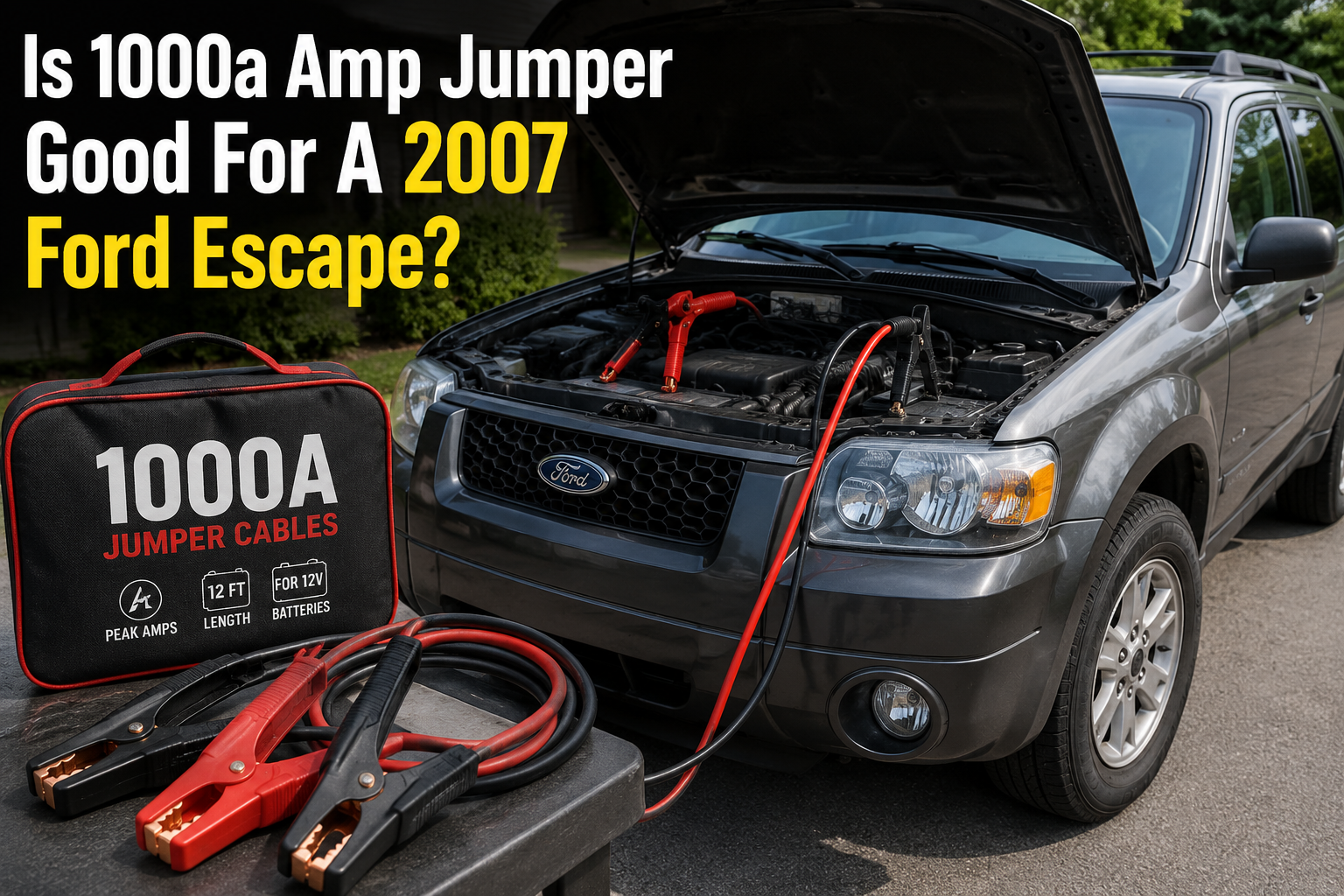
If your 2007 Ford Escape battery has died and you are standing in a parking lot holding a portable jump starter box, you have probably asked yourself one simple question: is 1000A amp jumper good for a 2007 Ford Escape, or do you need something stronger? This is one of the most common questions Escape owners search for, especially before a road trip, during winter, or right after buying a jump starter online without knowing exactly what the numbers mean.
The short answer is yes, a 1000A jump starter is generally more than enough to start a 2007 Ford Escape. But the full answer involves understanding your engine, your battery, the weather, and how “amps” are actually measured on these devices. This guide breaks everything down in simple language so you never have to guess again.
Understanding The 2007 Ford Escape’s Engine Specs
Before figuring out how much jump-starting power you need, it helps to know what is actually under the hood of your Escape. Ford offered the 2007 Escape with two main gasoline engine choices, and a hybrid version as well. Knowing which one you have makes a real difference in how much cranking power your engine actually demands from a dead battery.
The 2.3 liter four-cylinder engine was the base option, known for being fuel efficient and relatively easy on electrical demand. The 3.0 liter V6 was the upgraded option, offering more power but also asking a little more from the starter motor and battery during ignition. There was also a Ford Escape Hybrid trim that year, though hybrid batteries and jump-starting procedures work a bit differently and are not the main focus of this article.
Most factory batteries fitted to the 2007 Escape carry a cold cranking amps or CCA rating somewhere between 500 and 650 CCA, depending on the exact trim and climate package. This number represents how much current the battery itself can deliver to start the engine in cold conditions, and it becomes the benchmark we compare against jump starter output.
| Engine Option | Displacement | Typical Battery CCA | Starting Demand |
|---|---|---|---|
| I4 Base Engine | 2.3L | 500–550 CCA | Low to Moderate |
| V6 Engine | 3.0L | 550–650 CCA | Moderate |
| Hybrid | 2.3L + Electric Motor | Varies (Separate 12V Aux Battery) | Special Procedure Required |
As you can see from the table, none of the gasoline engine options come close to demanding anywhere near 1000 amps. This sets the stage for why a 1000A jump starter is considered strong enough for this vehicle, which we will explain in more detail in the next section.
What Does “1000A” Actually Mean?
This is where a lot of confusion happens, and honestly, it is not the buyer’s fault. Manufacturers of portable jump starters often print big, bold numbers on the packaging without clearly explaining what type of amperage they are referring to. Understanding the difference between these terms is the key to answering whether a 1000A jumper is good for your Escape or not.
There are generally three numbers you might see on a jump starter box, and they are not the same thing:
- Peak Amps (or Burst Amps): This is the maximum electrical output the device can deliver for a fraction of a second. The “1000A” label on most portable jump starters usually refers to this peak number, not a sustained output.
- Cranking Amps (CA): This measures the amount of current a device can supply for 30 seconds at a slightly warmer test temperature, usually around 32°F (0°C).
- Cold Cranking Amps (CCA): This is the most demanding rating, measuring output for 30 seconds at 0°F (-18°C), which is the standard most car batteries are rated by.
In simple terms, a jump starter marketed as “1000A” is not delivering a constant 1000 amps the entire time it is connected. It is capable of a short, powerful burst designed to get your engine turning over for the two or three seconds it actually needs to fire up. Once the engine starts, the jump starter’s job is essentially done, and your alternator takes over charging duties.
This is actually good news for Escape owners, because engines do not need sustained high amperage, they need a strong initial push. A 1000A peak-rated jump starter translates to a real-world CCA equivalent that is usually well above what a 2.3L or 3.0L engine requires, even accounting for manufacturer marketing exaggeration.
Is 1000A Enough For A 2007 Ford Escape?
Now to directly answer the core question: is 1000A amp jumper good for a 2007 Ford Escape? Based on the engine specifications and battery requirements outlined above, yes, it is more than sufficient for both the four-cylinder and V6 versions of this vehicle.
To put this in perspective, here is a simple comparison of what different vehicle types typically need versus what a 1000A jump starter can realistically deliver.
| Vehicle Type | Typical CCA Needed | 1000A Jumper Suitable? |
|---|---|---|
| 2007 Ford Escape I4 | 500–550 CCA | Yes, easily sufficient |
| 2007 Ford Escape V6 | 550–650 CCA | Yes, sufficient |
| Full-Size Pickup Truck (V8) | 650–800 CCA | Usually sufficient, borderline in extreme cold |
| Diesel Truck or SUV | 800–1200+ CCA | Often not enough, needs higher-rated jumper |
For your Escape specifically, whether you have the I4 or the V6, a good quality 1000A jump starter gives you a comfortable safety margin above what the engine actually demands. This margin matters because it accounts for real-world conditions where batteries do not perform at their theoretical best.
Does I4 vs V6 Change The Answer?
Not significantly. While the V6 engine does require slightly more cranking power than the I4, the difference is small enough that a 1000A jump starter comfortably covers both configurations. You would need to move into diesel or heavy-duty V8 territory before a 1000A rating starts becoming genuinely insufficient.
What About Cold Weather?
This is the one area where the answer becomes slightly more nuanced. Cold temperatures thicken engine oil and reduce battery chemical efficiency, meaning your engine actually needs more cranking amps to start in winter than it would on a mild day.
A 1000A jump starter still generally handles this fine for the Escape, but if you regularly deal with extreme winters, below 0°F (-18°C) for example, it is worth choosing a jump starter on the higher end of the 1000A range, or one that explicitly lists a strong CCA rating rather than just a peak amp number.
Benefits Of Using A 1000A Jump Starter
Beyond simply answering whether it is powerful enough, it is worth understanding why a 1000A portable jump starter has become such a popular choice for everyday drivers, including Escape owners.
One of the biggest advantages is portability. Unlike traditional jumper cables, which require flagging down another vehicle and lining up two cars hood to hood, a portable jump starter is a self-contained battery pack that fits in your glovebox or trunk. You can jump start your own vehicle alone, at any time, without needing anyone else’s help.
Modern 1000A jump starters also come packed with safety features that older jumper cable methods simply did not have. These typically include:
- Reverse polarity protection, which prevents damage if you accidentally connect the clamps backward
- Spark-proof technology, reducing the risk of dangerous sparking near the battery
- Overcurrent and short-circuit protection built into the internal circuitry
- Clear LED indicators showing connection status and charge level
Many of these devices are also multi-functional, doubling as a portable phone charger through USB ports, an emergency flashlight, and in some models, even a small air compressor for tires. This makes a 1000A jump starter a genuinely useful item to keep in your Escape year-round, not just for emergencies.
Potential Limitations To Keep In Mind
While a 1000A jump starter is a solid choice for a 2007 Ford Escape, it is not a magic solution for every situation. There are a few limitations worth understanding so you are never caught off guard.
If your Escape’s battery is extremely old, physically damaged, or has been sitting completely dead for an extended period, even a properly rated jump starter may struggle. In these cases, the issue is not the jump starter’s power, but the battery’s inability to hold or accept a charge at all. A battery in this condition usually needs replacement rather than repeated jump starts.
Extreme cold weather, as mentioned earlier, can also reduce a jump starter’s effective output. Lithium-based jump starters, which most modern 1000A units are, tend to lose some efficiency in very low temperatures, similar to how a phone battery drains faster in the cold. Keeping your jump starter in the cabin of your vehicle rather than the trunk during winter can help it maintain better performance.
Finally, the age and charge level of the jump starter itself matters. A jump starter that has not been charged in months, or one that is several years old and has degraded internally, will not perform at its rated 1000A capacity even if the label still says so. Regular charging maintenance, roughly once every one to three months when not in use, keeps the unit ready for when you actually need it.
How To Properly Jump Start A 2007 Ford Escape
Knowing that a 1000A jumper is good for your Escape is only half the picture, using it correctly matters just as much for safety and effectiveness. Here is a simple, step-by-step walkthrough.
- Turn off the ignition and make sure all electrical accessories, lights, and the radio are switched off in your Escape.
- Locate the battery. On most 2007 Escape models, the battery is located in the engine bay, though some V6 trims may have it positioned slightly differently, so check your owner’s manual if unsure.
- Turn on the jump starter and confirm it is sufficiently charged before connecting anything.
- Connect the red (positive) clamp to the positive terminal on the Escape’s battery, marked with a plus sign.
- Connect the black (negative) clamp to a solid, unpainted metal ground point on the engine block, not directly to the negative battery terminal, to reduce spark risk.
- Wait a few seconds, then attempt to start the engine as you normally would.
- Once started, remove the clamps in reverse order, black first, then red.
- Let the engine run for at least 15 to 20 minutes or take a drive so the alternator can recharge the battery.
Common Mistakes To Avoid
Even with a capable 1000A jump starter, mistakes during the process can cause damage or simply prevent a successful start. Avoid these common errors:
- Connecting the clamps in the wrong order or to the wrong terminals
- Attaching the negative clamp directly to the battery instead of a metal ground point
- Trying to jump start with the jump starter’s battery critically low
- Leaving the clamps connected for an extended period after the engine has started
- Assuming the jump starter is charged without checking the indicator first
Recommended Jump Starter Features To Look For
If you are shopping for a new jump starter for your 2007 Ford Escape, amperage alone should not be the only factor you consider. Here is what else genuinely matters.
Look for a unit with a real CCA rating listed, not just a peak amp number, since this gives a more honest picture of actual starting performance. A rating of 400 CCA or higher comfortably covers both the I4 and V6 versions of the Escape.
Lithium-ion jump starters are generally preferable over older lead-acid designs. They are lighter, hold their charge longer while sitting unused, and tend to perform more consistently across a wider temperature range, which matters if you live somewhere with real seasons.
Build quality and brand reputation also matter more than raw numbers. A well-reviewed jump starter from an established brand with proper safety certifications will almost always outperform a generic unlisted brand claiming a higher peak amp rating, since inflated marketing numbers are common in this product category.
Frequently Asked Questions
Can a 1000A jump starter start a V8 or diesel engine? In many cases yes, especially for smaller V8s in mild weather, but diesel engines and larger V8s often require significantly higher cranking amps, sometimes 1200 CCA or more, so a 1000A peak-rated unit may fall short, particularly in cold conditions.
How many times can I jump start a vehicle on one charge? This varies by device and battery condition, but most quality 1000A jump starters can perform anywhere from three to eight jump starts on a single full charge under normal conditions.
Is higher amperage always better? Not necessarily. Once a jump starter comfortably exceeds your vehicle’s actual CCA requirement, additional amperage mainly adds cost and bulk rather than meaningful extra benefit. For a 2007 Ford Escape, 1000A already provides a healthy safety margin without being excessive.
Can I damage my Escape’s electrical system with a 1000A jump starter? When used correctly, following proper connection order and polarity, a 1000A jump starter poses minimal risk to your Escape’s electrical system. Most damage cases stem from incorrect connections rather than the jump starter’s power output itself.
Conclusion
So, is 1000A amp jumper good for a 2007 Ford Escape? Based on everything covered in this guide, the answer is a confident yes. Whether your Escape has the 2.3L four-cylinder or the 3.0L V6 engine, a 1000A jump starter provides more than enough cranking power to reliably start your vehicle under normal and even moderately cold conditions.
The key takeaway is that raw amperage numbers only tell part of the story. Pairing a properly rated 1000A jump starter with good habits, regular charging, correct connection procedure, and awareness of your battery’s actual health, will keep your Escape ready to start no matter where you park it.
Related Articles
How Much Does a Ford F150 Weigh? Full Weight Guide by Trim, Cab & Engine
Is Ford American Made? The Complete Truth About Ford’s Manufacturing
How To Change Battery In Ford Key Fob? Easy Step-by-Step Guide