





Introduction
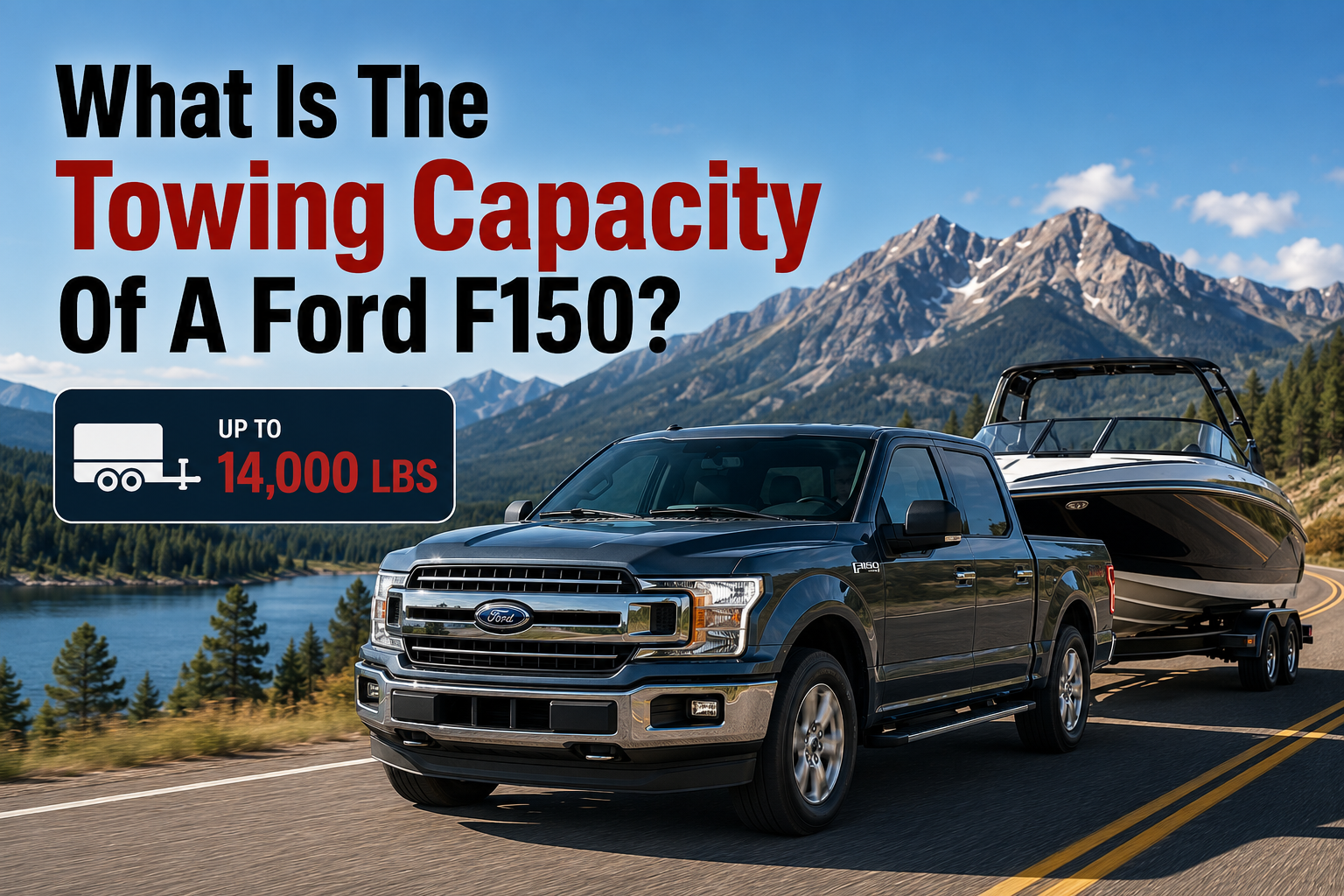
If you are shopping for a half-ton pickup, chances are you have already typed the question into a search bar: what is the towing capacity of a Ford F150? It is one of the most common questions truck buyers ask, and for good reason. Towing capacity tells you how much weight your truck can safely pull behind it, and getting this number wrong can lead to a dangerous or even illegal situation on the road.
The honest answer is that there is no single figure that applies to every F-150. The towing capacity of a Ford F150 depends heavily on which engine is under the hood, which cab and bed combination you choose, whether you have four-wheel drive, what axle ratio is fitted, and whether the truck came with a proper towing package. In simple terms, two F-150s that look identical from the outside can have towing numbers that are thousands of pounds apart.
In this guide, we will walk through everything in plain, easy language. You will learn how towing capacity is measured, how it changes across engines and trims, how it compares across recent model years, and how to find the exact number for your own truck. We will also cover payload, since many buyers confuse the two, and finish with practical tips so that whatever you tow, you tow it safely.
What Towing Capacity Actually Means
Towing capacity is the maximum weight a vehicle is rated to pull behind it, measured as the weight of a fully loaded trailer. It is not the same as the weight the truck itself weighs, and it is not the same as how much weight you can put in the bed. Manufacturers calculate this number using a combination of engine output, frame strength, brake performance, cooling capacity, and axle strength, then test it against strict safety standards.
When Ford or any other manufacturer publishes a towing figure, that number represents the best-case scenario for a specific, properly equipped version of the truck. This is why the same model name can carry very different towing numbers depending on what is actually bolted onto it at the factory.
Ford F-150 Towing Capacity By Year
Towing numbers on the F-150 have shifted over time as Ford introduced new engines, updated cooling systems, and refined its towing packages. Here is a simple breakdown of how the maximum towing figure has moved across recent years.
| Model Year | Maximum Towing Capacity |
|---|---|
| 2015 | 12,200 lbs |
| 2016 | 12,200 lbs |
| 2017 | 12,200 lbs |
| 2018 | 13,200 lbs |
| 2019 | 13,200 lbs |
| 2020 | 13,200 lbs |
| 2021 | 14,000 lbs |
| 2022 | 14,000 lbs |
| 2023 | 14,000 lbs |
| 2024 | 13,500 lbs |
| 2025 | 13,500 lbs |
| 2026 | 13,500 lbs |
A quick look at this table shows that towing capacity is not something that only goes up year after year. The 2021 through 2023 model years actually reached the highest peak at 14,000 pounds, while more recent trucks settled at 13,500 pounds as Ford adjusted its engine lineup and towing equipment. If you are shopping used, this means an older F-150 is not automatically less capable than a newer one, so it always pays to check the specific configuration rather than assuming based on age alone.
Towing Capacity By Engine Type
Engine choice is the single biggest factor influencing what is the towing capacity of a Ford F150 you are considering. The current F-150 lineup offers several engines, and each one is tuned for a different kind of buyer, from budget-conscious commuters to serious haulers.
2.7L EcoBoost V6 This is one of the more efficient engines in the lineup, and it still delivers solid towing performance for a mid-range engine. The 2.7L EcoBoost V6 is rated for up to 8,400 pounds of maximum towing, along with 1,775 pounds of maximum payload. This engine suits buyers who tow occasionally, such as pulling a small boat, a utility trailer, or a couple of ATVs.
5.0L Ti-VCT V8 The naturally aspirated V8 remains popular with buyers who prefer a traditional engine feel. It is rated for up to 12,900 pounds of towing and 2,225 pounds of payload. This engine strikes a strong balance between everyday drivability and serious hauling power.
3.5L EcoBoost V6 This is the engine that delivers the truck’s headline towing number. The 3.5L EcoBoost V6 tops out at 13,500 pounds of maximum towing and 2,440 pounds of maximum payload, making it the strongest engine in the regular lineup. This engine also produces 500 lb-ft of torque, which helps it outperform most rivals in the light-duty segment.
3.5L Power Boost Full Hybrid V6 The hybrid powertrain blends fuel efficiency with genuine towing muscle. The Power Boost Hybrid offers up to 11,600 pounds of towing capacity, along with the added benefit of Pro Power Onboard for running tools and appliances at a job site or campsite. This engine also produces the most torque in the entire lineup at 570 lb-ft, which makes it especially smooth when getting a heavy trailer moving from a complete stop.
High-Output 3.5L EcoBoost V6 This version of the EcoBoost engine is tuned more for performance-oriented trims. It is rated for 8,200 pounds of maximum towing and 1,400 pounds of maximum payload.
5.2L Supercharged V8 This high-performance engine is rated at 8,700 pounds of maximum towing. It is generally paired with performance-focused trims rather than heavy-duty work trucks.
All-Electric F-150 Lightning For buyers considering the electric option, the all-electric Lightning can tow up to 10,000 pounds and provides instant torque for confident acceleration from a stop.
Simple Comparison Table Of Engines
| Engine | Max Towing Capacity | Max Payload |
|---|---|---|
| 2.7L EcoBoost V6 | 8,400 lbs | 1,775 lbs |
| High-Output 3.5L EcoBoost V6 | 8,200 lbs | 1,400 lbs |
| 5.2L Supercharged V8 | 8,700 lbs | Varies by trim |
| 5.0L Ti-VCT V8 | 12,900 lbs | 2,225 lbs |
| 3.5L PowerBoost Hybrid V6 | 11,600 lbs | 1,750 lbs |
| 3.5L EcoBoost V6 | 13,500 lbs | 2,440 lbs |
| F-150 Lightning (Electric) | 10,000 lbs | Varies by trim |
Factors That Affect Towing Capacity Beyond The Engine
Engine choice sets the ceiling, but several other factors determine whether a specific truck actually reaches that ceiling. Understanding these details helps you avoid the common mistake of assuming every F-150 with a certain engine can tow the same amount.
Cab style and bed length. Regular cab, SuperCab, and SuperCrew configurations all weigh different amounts, and a heavier cab generally reduces the towing ceiling slightly since more of the truck’s overall capacity goes toward supporting the cab itself.
Drivetrain. Four-wheel-drive trucks weigh more than their two-wheel-drive counterparts, which can shave a small amount off the maximum towing figure in certain configurations.
Axle ratio. A numerically higher axle ratio, such as 3.73 instead of 3.31, generally improves towing capability because it gives the engine more mechanical advantage when pulling heavy loads, even though it may slightly reduce fuel economy.
Trim level. Some trims, especially off-road-oriented ones, prioritize suspension travel and ground clearance over outright towing strength. Tremor and Raptor trims fall into this category, since their long-travel suspensions are built to absorb bumps rather than carry maximum weight, which caps their towing figures noticeably lower than standard trims.
Towing package. This is arguably the most overlooked factor. The Tow/Haul Package serves as the foundation for serious towing capability, and it typically includes an integrated trailer brake controller, upgraded cooling systems, and an electronic locking rear axle. Without this package, most F-150 configurations top out well below their advertised maximum, sometimes falling between 8,000 and 11,000 pounds even with the strongest engine installed.
Understanding The Max Trailer Tow Package
The Max Trailer Tow Package, sometimes paired with an additional Max Tow Axle upgrade, is what unlocks the truck’s highest advertised numbers. This package is generally available across a wide span of trims, from entry-level XL models all the way up to Platinum, provided the correct engine and axle combination is selected.
What does this package typically add? It brings together the components needed to tow safely at higher weights, including a heavier-duty cooling system to prevent the engine and transmission from overheating under strain, a factory-integrated trailer brake controller so the trailer’s brakes work in sync with the truck’s, and hitch receiver hardware rated for the higher weight class. Buyers who plan to tow anything heavier than a light utility trailer should treat this package as close to mandatory rather than optional.
Payload Versus Towing Capacity
These two numbers get mixed up constantly, so it is worth explaining the difference clearly.
Towing capacity refers to the weight of a trailer being pulled behind the truck, connected through a hitch. Payload refers to the weight carried inside the truck itself, meaning passengers, cargo in the bed, and anything added to the vehicle like a topper or tool box.
Both numbers matter together because the tongue weight of a trailer, which is typically around ten percent of its total loaded weight, actually counts against your payload rating rather than your towing rating.
This means a truck might technically be rated to tow 13,500 pounds, but if it is already loaded down with passengers, gear, and a heavy hitch, the payload limit could become the real restriction before the towing number ever comes into play. Responsible towing means checking both figures, not just the flashier towing number.
How To Find The Exact Towing Capacity Of Your F-150
Since the advertised maximum only applies to one specific configuration, the safest approach is always to check your own vehicle directly rather than relying on general marketing figures. There are three reliable ways to do this.
- Check the door jamb sticker. Every F-150 has a certification label on the driver’s side door jamb listing the Gross Vehicle Weight Rating and other key figures specific to that exact truck.
- Look up the VIN. Ford’s build data tied to your Vehicle Identification Number will show the exact engine, axle ratio, and packages installed at the factory.
- Read the owner’s manual. The manual includes detailed towing charts broken down by configuration, which is more precise than any general advertisement.
Tips For Safe And Effective Towing
Knowing the number is only half the job. Towing safely requires a bit of preparation regardless of how capable your truck is on paper.
- Always weigh your trailer fully loaded rather than relying on the manufacturer’s listed dry weight, since actual loaded weight is usually higher.
- Add roughly ten percent of the trailer’s loaded weight as an estimate for tongue weight, and confirm your payload rating can absorb it.
- Use a weight distribution hitch for larger trailers, since this helps spread the load evenly across all axles instead of concentrating it at the rear.
- Confirm your trailer brakes are functioning and properly matched to a factory-integrated brake controller if your truck has one.
- Check your Gross Combined Weight Rating, which accounts for the truck, passengers, cargo, and trailer all together, since this figure can become the true limiting factor even when the towing capacity alone looks sufficient.
- Take note of standard safety systems as well. Every modern F-150 includes Trailer Sway Control, a system that detects side-to-side trailer movement and applies selective braking automatically to help keep the setup stable at highway speeds.
Conclusion
So, what is the towing capacity of a Ford F150? The honest answer is that it ranges from roughly 8,200 pounds on lighter-duty engines all the way up to 13,500 pounds on a properly equipped 3.5L EcoBoost model with the Max Trailer Tow Package and the right axle.
The exact figure for any individual truck depends on its engine, cab and bed configuration, drivetrain, axle ratio, and installed towing package, so the only way to know your true number is to check your specific vehicle rather than relying on a single advertised figure.
For most casual buyers, the 2.7L EcoBoost or 5.0L V8 will comfortably cover boats, small campers, and utility trailers. For buyers who regularly haul heavy equipment, large travel trailers, or livestock, stepping up to the 3.5L EcoBoost with the full towing package is the safest and most capable choice.
Whatever you decide to tow, matching your trailer’s actual loaded weight against your truck’s true rated capacity, rather than its headline number, is what keeps every trip safe.
Related Articles
What Does XLT Stand For on a Ford? Complete Trim Level Guide
How to Connect Phone to Ford SYNC to Play Music? Complete 2026 Guide
Is Ford Escape A Good Car? Complete Reliability, Performance & Buyer’s Guide
Why Don’t Ford MAF Engines Use a MAP Sensor? Complete Explanation
How Much Does a Ford F150 Weigh? Full Weight Guide by Trim, Cab & Engine