





1. Introduction
If you are shopping for a midsize three-row SUV, one of the very first questions that probably comes to mind is: how long is a Ford Explorer? It’s a fair question, because length affects almost everything about ownership — whether the SUV fits in your garage, how easy it is to parallel park, how much room your family gets inside, and how much gear you can haul on a road trip.
The Ford Explorer has been a staple of the American SUV market for decades, and the current generation continues that tradition by balancing a spacious cabin with a footprint that still feels manageable on city streets and in tight parking lots.
In this guide, we will walk through every important measurement of the Explorer in plain, easy-to-understand language — from its overall length and width to its interior legroom, cargo volume, towing capacity, and how it stacks up against rival SUVs. By the end, you should have a clear, complete picture of exactly how long a Ford Explorer is and what that size means for your day-to-day life.
2. Exterior Dimensions
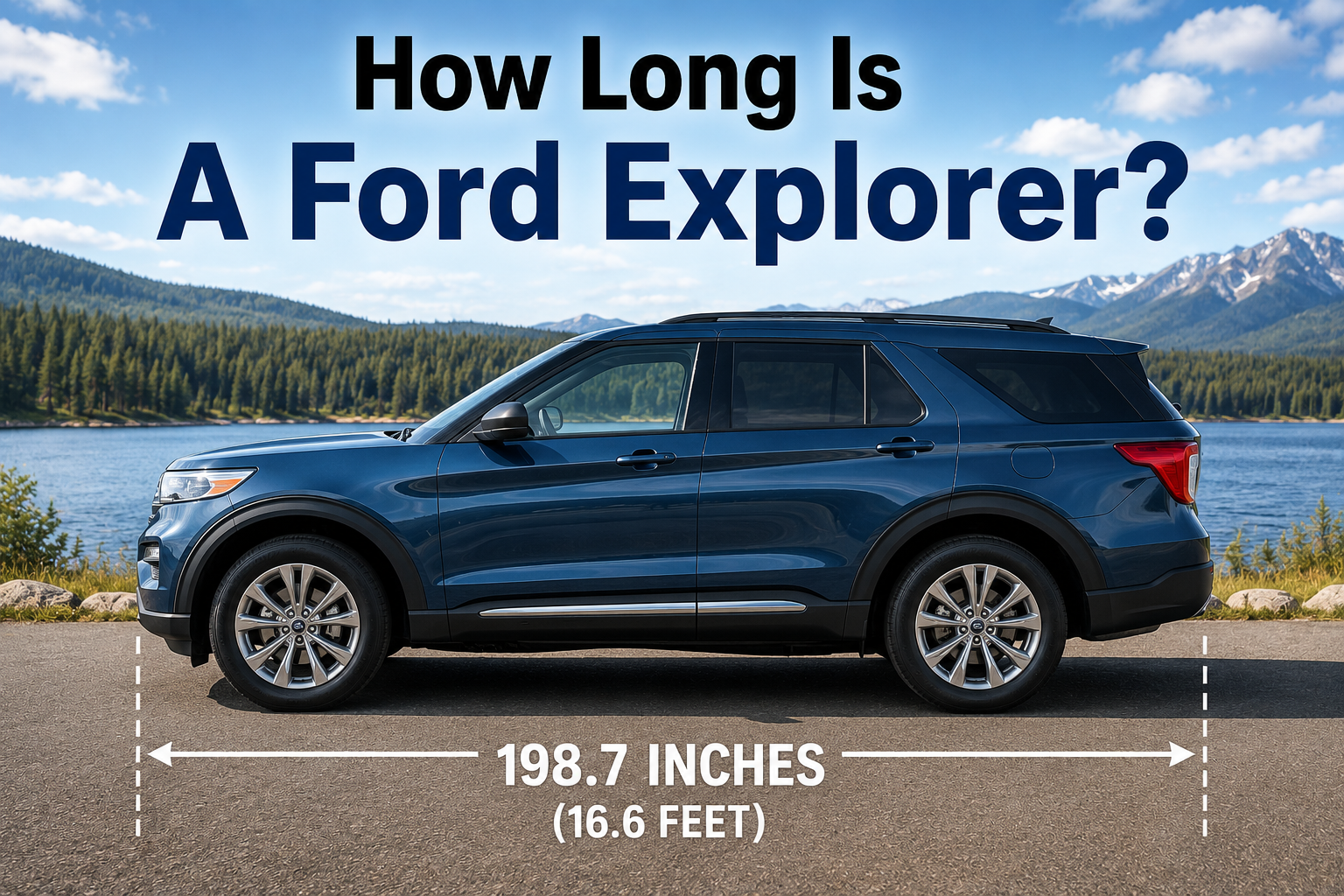
Let’s start with the number most people are searching for. So, how long is a Ford Explorer? The current model measures right around 198.7 to 198.8 inches in overall length, which works out to roughly 16.5 to 16.6 feet. That length has stayed fairly consistent in recent years, so if you’re comparing model years, you won’t see dramatic swings in size from one year to the next.
Length alone doesn’t tell the full story, though. Here is a simple breakdown of the other exterior measurements that matter just as much when you’re deciding whether the Explorer will comfortably fit your lifestyle and your garage.
| Measurement | Specification |
|---|---|
| Overall Length | 198.7 inches |
| Wheelbase | 119.1 inches |
| Width (excluding mirrors) | 78.9 inches |
| Width (including mirrors) | 89.3 inches |
| Width (mirrors folded) | 82.7 inches |
| Height (Active, ST-Line trims) | 69.6 inches |
| Height (ST trim) | 69.8 inches |
| Height (Platinum trim) | 70.2 inches |
| Height (Tremor trim) | 70.8 inches |
| Front Overhang | 33.6 inches |
| Rear Overhang | 46 inches |
| Ground Clearance (base trims) | 7.6 inches |
Notice that the height changes depending on which trim you pick, mostly because of differences in suspension tuning, wheel and tire sizes, and roof-mounted equipment like antennas or roof rails. The wheelbase — the distance between the front and rear axles — plays a big role in ride comfort and interior space, since a longer wheelbase generally means more legroom for passengers, especially in the second row.
The turning diameter is another practical number worth knowing. The Explorer’s turning circle comes in at roughly 38.7 feet, which gives it decent maneuverability for a vehicle of its size, whether you’re navigating a crowded parking garage or making a U-turn on a narrower street.
3. Interior Dimensions
Exterior length is only half the equation. What really matters for families is how that length translates into usable cabin space. The Explorer’s cabin is designed to keep passengers comfortable across all three rows, though naturally the third row is tighter than the front two, which is typical for this vehicle class.
Here’s how the passenger space breaks down:
| Row | Headroom | Legroom | Shoulder Room | Hip Room |
|---|---|---|---|---|
| First Row | 40.7 inches | 43 inches | 62.1 inches | 59.2 inches |
| Second Row | 40.5 inches | 37.5 inches | 61.9 inches | 59.1 inches |
| Third Row | 38.9 inches | 31.8 inches | 54.6 inches | 40.9 inches |
It’s worth noting that sportier and more luxury-oriented trims shift these numbers slightly. For example, the Platinum trim measures 38.9 inches of headroom in the first row and 38.2 inches in the second row, a bit tighter than the standard trims because of features like the panoramic sunroof housing. Similarly, the ST, Platinum, and Tremor trims offer 42.9 inches of front legroom and 37 inches in the second row, a slight difference from the base configuration.
In everyday terms, this means adults can ride comfortably in the front and second rows for long road trips, while the third row is better suited to children or shorter adults for shorter journeys — again, a common trait among midsize three-row SUVs rather than something unique to the Explorer.
4. Cargo Space
One of the biggest reasons people choose an SUV like the Explorer over a sedan or a smaller crossover is cargo flexibility. The Explorer offers a generous, configurable cargo area that adjusts depending on how many rows of seating you need at any given time.
- Cargo space behind the third row: 16.3 cubic feet
- Cargo space behind the second row: 46 cubic feet
- Cargo space behind the first row (both rear rows folded): 85.8 cubic feet
- Maximum cargo capacity with all rear seats folded: up to 87.8 cubic feet depending on configuration
This tiered cargo system means the Explorer can adapt to almost any situation. Heading out for a weekend grocery run with the whole family? You still get over 16 cubic feet of trunk space even with all three rows in use, enough for several bags of groceries or a couple of suitcases.
Need to haul furniture, camping gear, or flat-packed boxes? Folding down the third row alone nearly triples your available space, and folding both rear rows opens up enough room for large, bulky items.
5. Seating Capacity
The Ford Explorer is built as a three-row SUV, and depending on the configuration you choose, it can seat up to seven passengers comfortably. Some trims offer a bench-style second row to maximize seating count, while others swap in second-row captain’s chairs for a more premium, individualized seating feel — though this typically reduces total capacity to six passengers since it removes the middle seat.
Families cross-shopping the Explorer often appreciate this flexibility because it lets you choose between maximizing headcount for carpools and larger families, or maximizing comfort and aisle access for smaller households that value easy movement between rows.
6. Weight & Towing Specifications
Size isn’t just about how long or wide a vehicle is — weight and towing capability matter just as much, especially for buyers who plan to haul trailers, boats, or campers. While exact towing figures vary depending on engine choice and drivetrain, the Explorer lineup is generally built to handle moderate to heavy towing tasks that fall well within what most family SUVs in this class can manage, making it a practical option for weekend adventurers as well as daily commuters.
Buyers considering towing should always check the specific configuration they intend to purchase, since engine choice, all-wheel drive availability, and optional towing packages can shift these numbers noticeably from one trim to another.
7. Dimensions By Generation and Model Year
One reassuring point for current and prospective owners is stability. According to available data, the recent model year’s dimensions are nearly identical to the prior year, with no major changes to length, wheelbase, or cargo space.
This kind of consistency means that if you already own an Explorer, or if you’re comparing model years while shopping, you generally won’t run into major surprises in terms of how the vehicle fits your garage, your parking situation, or your existing roof racks and accessories.
Over previous generations, Ford has gradually refined the Explorer’s proportions, generally keeping the overall length in a similar range while adjusting wheelbase and interior packaging to improve passenger comfort and cargo access.
8. Comparison With Competitors
So how does the answer to “how long is a Ford Explorer” stack up against other three-row SUVs on the market? Broadly speaking, the Explorer sits comfortably in the middle of the pack for exterior length, described as slightly longer than the Honda Pilot while offering more maximum cargo room than some rivals in the segment.
It is also frequently placed alongside the Toyota Highlander and Chevrolet Traverse as a natural cross-shop, since all three target similar buyers looking for family-friendly space without stepping up to a full-size SUV.
The practical takeaway is this: if you’re choosing between these midsize three-row options, the differences in length are often measured in inches rather than feet, so your decision may come down more to cargo configuration, interior tech, ride comfort, and pricing than to raw size alone.
9. Trim-Specific Variations
While the Explorer’s core length, width, and wheelbase remain largely the same across the lineup, several trims introduce small but meaningful differences, mostly related to height and ground clearance.
- Active / ST-Line: Standard height at 69.6 inches, offering a balanced everyday driving experience.
- ST: Slightly taller at 69.8 inches, with sportier suspension tuning.
- Platinum: Steps up to 70.2 inches, geared toward a more premium, upscale driving position.
- Tremor: The tallest of the lineup at 70.8 inches, paired with about 8.7 inches of ground clearance, thanks to an off-road-tuned suspension, larger all-terrain tires, and additional underbody protection.
That extra ground clearance on the Tremor isn’t just a cosmetic difference — it meaningfully improves the vehicle’s approach and departure angles, which matters if you’re planning to take your Explorer off paved roads and onto trails.
10. Practical Implications
Numbers on a spec sheet are useful, but what do they actually mean for your daily life? Here’s a breakdown of the practical side of the Explorer’s size.
Garage and parking fit: At under 200 inches long and under seven feet wide with mirrors folded, the Explorer fits into the vast majority of standard U.S. garages and parking spaces without issue. Most residential garages are built with well over 20 feet of depth, so a vehicle just over 16.5 feet long leaves reasonable clearance front and back.
Family use: With seating for up to seven and a flexible cargo system, the Explorer suits larger families who need both passenger space and the ability to haul gear for sports, school, or travel.
Off-road use: If trail driving is part of your plans, the Tremor trim’s added height and ground clearance make it the natural choice within the lineup, while the standard trims are better suited to pavement-focused, everyday driving.
Towing and hauling: Buyers who need to tow trailers, boats, or campers should confirm the towing package and drivetrain on their specific configuration, since this can shift meaningfully by trim and engine choice.
11. Conclusion
To sum it all up: the answer to how long is a Ford Explorer comes in at approximately 198.7 to 198.8 inches, or about 16.5 to 16.6 feet, with a 119.1-inch wheelbase and a width of 78.9 inches excluding mirrors.
Height varies modestly by trim, ranging from 69.6 inches on standard models up to 70.8 inches on the off-road-oriented Tremor. Inside, the Explorer offers generous passenger room across its first two rows, a usable but tighter third row, and a highly flexible cargo area that scales from about 16 cubic feet up to nearly 88 cubic feet depending on how the seats are configured.
Ultimately, the Ford Explorer’s size strikes a practical balance — spacious enough for a growing family’s gear and passengers, yet manageable enough to park, garage, and maneuver in everyday driving.
Whether you’re drawn to the standard trims for daily commuting, the ST for a sportier feel, the Platinum for upscale comfort, or the Tremor for weekend trail adventures, the Explorer’s dimensions are built to support a genuinely versatile ownership experience.
Related Articles
What Is The Towing Capacity Of A Ford F150? Full 2026 Guide
What Does XLT Stand For on a Ford? Complete Trim Level Guide
How to Connect Phone to Ford SYNC to Play Music? Complete 2026 Guide
Is Ford Escape A Good Car? Complete Reliability, Performance & Buyer’s Guide
Why Don’t Ford MAF Engines Use a MAP Sensor? Complete Explanation