






Introduction
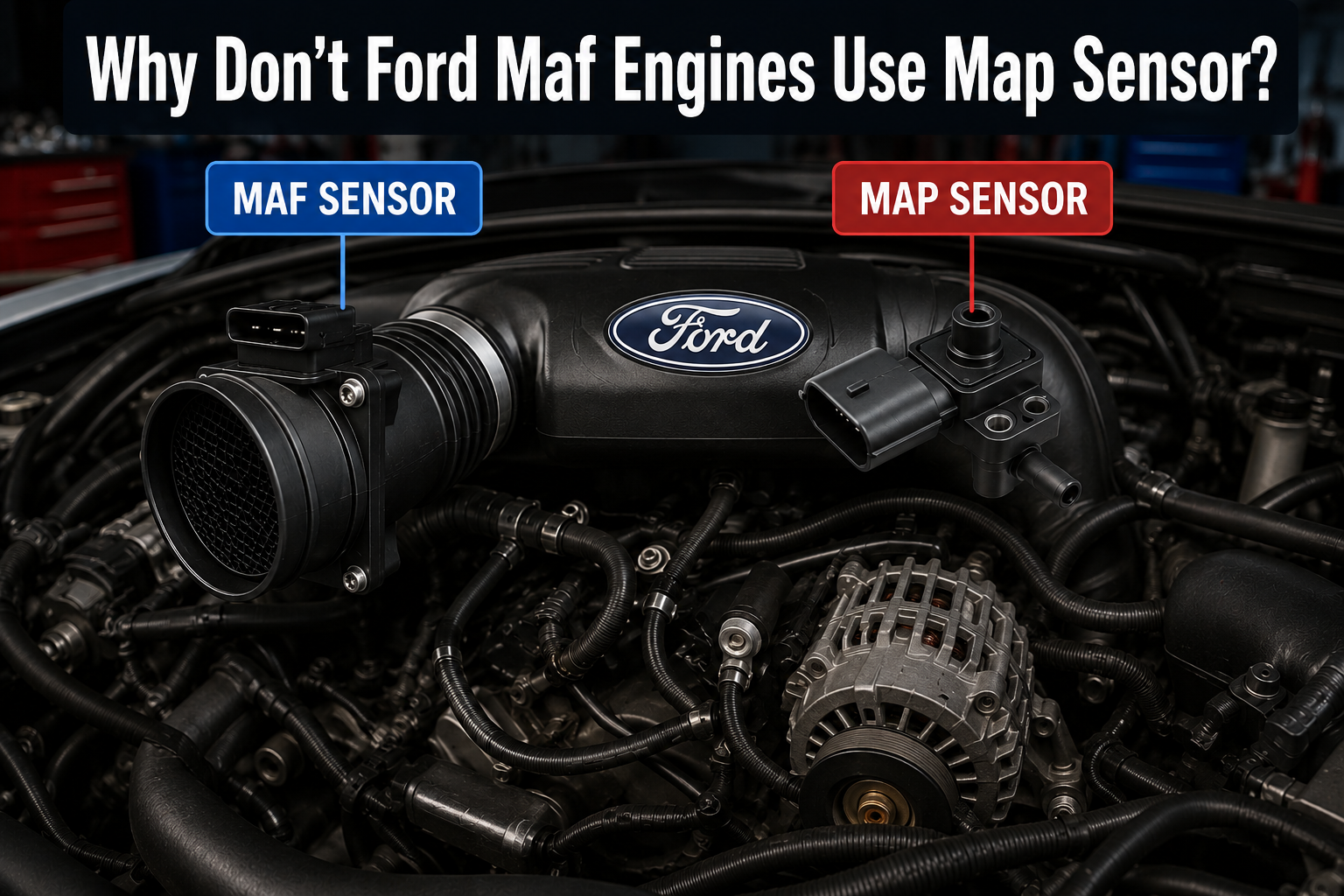
If you have ever opened the hood of a Ford and gone looking for a MAP sensor, only to find that it simply isn’t there, you are not alone. Many Ford owners and even some new mechanics ask the same question: why don’t Ford MAF engines use a MAP sensor the way many other manufacturers do? The short answer is that Ford’s MAF-only engines already get everything they need from the Mass Air Flow sensor, so adding a Manifold Absolute Pressure sensor becomes unnecessary extra hardware in most cases.
To understand this properly, it helps to step back and look at how an engine decides how much fuel to inject at any given moment. Every gasoline engine needs to know how much air is entering the cylinders so the onboard computer, called the ECU (Engine Control Unit), can match that air with the correct amount of fuel.
There are two common ways engineers get this information: measuring air directly with a MAF sensor, or calculating it indirectly using a MAP sensor along with other data. Ford, for a large portion of its naturally aspirated engine lineup, chose the direct measurement route, and that decision is really the heart of this whole topic.
This article walks through both sensor types in plain, easy language, explains exactly why Ford favors the MAF-only approach on many models, and also covers the situations where Ford does combine both sensors together. By the end, you will have a complete and practical understanding of this topic, whether you are a curious owner, a student, or someone troubleshooting a check engine light.
Understanding the MAF Sensor
MAF stands for Mass Air Flow. As the name suggests, this sensor measures the actual mass of air flowing into the engine in real time. It usually sits inside the intake tube, right between the air filter housing and the throttle body, so that every bit of air the engine breathes has to pass directly through or across the sensor.
Most Ford vehicles use what is called a hot-wire MAF sensor. Inside the sensor housing there is a very thin wire or film element that is heated to a set temperature by an electrical current. As air flows past this heated element, it naturally cools it down.
The sensor’s circuitry constantly works to keep the element at its target temperature, and the amount of electrical current needed to do that is directly related to how much air is flowing past it. More airflow pulls more heat away, so more current is needed, and the sensor converts this changing current into a voltage or frequency signal that the ECU can read.
Because this measurement happens in real time and reflects actual air density, temperature, and volume all at once, the MAF sensor gives the ECU a very accurate picture of exactly how much air the engine is taking in at that exact moment, regardless of altitude, weather, or engine wear. This single reading allows the ECU to calculate the correct fuel injector pulse width almost instantly.
Understanding the MAP Sensor
MAP stands for Manifold Absolute Pressure. Unlike the MAF sensor, it does not measure airflow directly. Instead, it measures the air pressure inside the intake manifold, which sits after the throttle body and just before the intake valves.
A MAP sensor is typically a small sealed unit connected to the intake manifold either directly or through a vacuum hose. Inside it, a pressure-sensitive diaphragm reacts to changes in manifold pressure and sends a corresponding voltage signal to the ECU.
When the throttle is closed and the engine is idling, manifold pressure is low, which shows up as high vacuum. When the throttle opens wide, pressure rises closer to atmospheric levels.
The ECU cannot use pressure alone to know how much fuel to add. It has to combine the MAP reading with other information, such as engine speed (RPM), intake air temperature, and known engine displacement, then run that data through a mathematical model to estimate how much air mass is actually entering the cylinders. This estimation approach is what engineers call the speed-density method, and it is explained further in the next section.
Core Difference Between MAF and MAP Systems
The real difference between these two systems comes down to direct measurement versus indirect calculation.
A MAF-based system physically measures the air as it moves past the sensor. There is very little guesswork involved because the ECU is working with a real, live number that already accounts for temperature, humidity, and density changes automatically.
A MAP-based system, on the other hand, relies on the speed-density method. In this approach, the ECU takes the manifold pressure reading, factors in engine RPM and intake air temperature, and then uses a pre-programmed table of values (built and tested by engineers for that specific engine) to estimate the incoming air mass. It is a smart calculation, but it is still a calculation rather than a direct measurement, so it depends heavily on how well those tables were tuned during engine development.
Here is a simple table comparing the two methods side by side:
| Feature | MAF (Mass Air Flow) | MAP (Manifold Absolute Pressure) |
|---|---|---|
| Measurement type | Direct airflow measurement | Indirect pressure-based calculation |
| Method used | Hot-wire or hot-film sensing | Speed-density estimation |
| Needs extra inputs | Rarely, mostly works alone | Yes, needs RPM and intake air temperature |
| Accuracy in changing conditions | Very high, self-adjusting | Depends on tuning accuracy |
| Common on | Naturally aspirated engines | Turbocharged or older carbureted-style setups |
| Sensitivity to dirt | High, contamination affects reading | Low, less affected by dirt |
Understanding this core difference makes it much easier to answer the main question people search for, which is why don’t Ford MAF engines use a MAP sensor when a MAP-only design is also technically possible.
Why Ford Chooses MAF-Only Systems?
Ford’s engineering decision to rely mainly on the MAF sensor for a large number of its engines comes down to a handful of practical advantages.
The first reason is simplicity and lower cost. A MAF-only system needs fewer components, less wiring, and a simpler calibration process during engine development. Every extra sensor adds cost to manufacturing and slightly increases the chance of a future failure point, so if one sensor can do the job well, automakers naturally prefer to avoid adding another.
The second reason is accuracy under real-world driving conditions. Since the MAF sensor measures actual air mass rather than estimating it, it automatically compensates for changes in altitude, outside temperature, humidity, and even engine wear over time. A MAP-based system depends on pre-programmed tables that were calibrated under specific test conditions, so it can drift slightly out of accuracy as conditions change or as the engine ages.
The third reason is reduced calibration complexity. Tuning a speed-density system properly requires extensive testing across many RPM ranges, loads, and temperatures to build an accurate table. A MAF-based system requires far less of this table-building work because it is reading real numbers directly.
The fourth reason is fewer potential failure points. Every additional sensor and connector in a vehicle is one more thing that can wear out, corrode, or develop a wiring fault. By relying on a single, well-proven MAF sensor for load calculation, Ford simplifies the overall system.
Finally, a MAF sensor generally provides better real-time throttle response because the ECU receives an immediate, direct signal rather than working through an estimation model, which can help the engine feel more responsive to sudden throttle inputs.
Situations Where Ford Still Uses Both Sensors
It’s important to understand that Ford does not avoid MAP sensors entirely. On several engine families, particularly turbocharged and supercharged ones, Ford uses both a MAF and a MAP sensor together.
Forced induction engines create a unique challenge. Once boost pressure builds beyond normal atmospheric pressure, the airflow behavior inside the intake becomes more complex, and a MAP sensor becomes very useful for tracking boost levels accurately and protecting the engine from over-boost conditions. In these cases, the MAP sensor works alongside the MAF sensor rather than replacing it, giving the ECU cross-referenced data for both airflow and manifold pressure.
This combination also provides valuable redundancy. If the MAF sensor becomes dirty, damaged, or fails outright, the ECU can lean on the MAP sensor’s data to keep the engine running in a limited or “limp mode” capacity, rather than stalling completely. This is especially useful for diagnostics, since technicians can compare MAF and MAP readings against each other to pinpoint exactly which sensor or system is malfunctioning.
Ford’s turbocharged EcoBoost lineup is the clearest real-world example of this dual-sensor setup, since these engines benefit from the added precision and safety margin that a MAP sensor provides under boosted conditions.
Advantages of a MAF-Only Setup
A MAF-only configuration brings several practical benefits to naturally aspirated Ford engines. It naturally adjusts for changes in altitude and outside temperature without needing extra correction tables, since the sensor is already reading real air mass.
It tends to produce more precise fuel trims because the ECU is not relying on an estimation model. It also allows for simpler wiring and a less complicated ECU programming process, which can make long-term diagnostics and repairs a bit more straightforward for technicians who are familiar with the system.
Disadvantages and Limitations of a MAF-Only Setup
No system is perfect, and the MAF-only approach does have some real drawbacks worth knowing about.
Because the sensor’s hot-wire or hot-film element sits directly in the airstream, it is quite sensitive to dirt, oil residue (especially from aftermarket oiled air filters), and general contamination. Even a light coating of dust can throw off the readings.
A failing or dirty MAF sensor can also cause problems that develop gradually, such as a rough idle, hesitation during acceleration, or reduced fuel economy, without necessarily triggering an obvious warning right away.
Perhaps the biggest limitation is that on engines without a backup MAP sensor, a complete MAF failure can leave the ECU with very little accurate airflow data to work from, which can cause rough running or a noticeable drop in performance until the sensor is cleaned or replaced.
How This Affects Engine Performance and Diagnostics?
When a MAF sensor starts to fail or becomes contaminated, it commonly triggers diagnostic trouble codes that point directly to the affected circuit. Some of the most common codes include:
- P0101 – Mass Air Flow Circuit Range/Performance Problem
- P0102 – Mass Air Flow Circuit Low Input
- P0103 – Mass Air Flow Circuit High Input
When technicians see one of these codes, they typically start by visually inspecting the sensor for dirt or damage, checking the wiring harness and connector for corrosion, and comparing live sensor data on a scan tool against expected values at idle and during acceleration.
On engines that also have a MAP sensor, comparing the two readings side by side makes it much easier to isolate whether the MAF, the MAP, or another related component (like a vacuum leak) is the true source of the problem.
Typical warning signs of a failing MAF sensor include a rough or unstable idle, hesitation or stumbling during acceleration, noticeably reduced fuel economy, and in some cases the engine stalling shortly after starting.
Comparison Table: MAF-Only vs MAF Plus MAP Systems
| Category | MAF-Only System | MAF + MAP System |
|---|---|---|
| Typical use case | Naturally aspirated Ford engines | Turbocharged or supercharged Ford engines |
| Manufacturing cost | Lower | Slightly higher |
| Airflow accuracy | Very high under normal conditions | Very high, with added boost monitoring |
| Redundancy if a sensor fails | Limited | Better, MAP can back up MAF data |
| Complexity of tuning | Simpler | More complex, requires cross-calibration |
| Sensitivity to altitude changes | Self-adjusting | Self-adjusting, plus boost correction |
Real-World Examples on Ford Models
Many of Ford’s traditional naturally aspirated engines, including numerous four-cylinder and V6 options found in models like the Focus, Fusion, and older F-150 configurations, have historically relied on a MAF-only setup for fuel and airflow calculations. This fits the pattern already discussed, since these engines do not face the added pressure complexity that comes with forced induction.
On the other hand, Ford’s turbocharged EcoBoost engines, found across models such as the F-150, Escape, and Explorer, commonly use both a MAF sensor and a MAP sensor together. This dual setup helps the ECU manage boost pressure precisely while still benefiting from the accuracy of direct airflow measurement.
Maintenance Tips for MAF Sensors
Because the MAF sensor plays such a central role in engines that don’t have a MAP sensor as backup, keeping it clean and functioning properly is genuinely important.
Most manufacturers and mechanics recommend cleaning the MAF sensor every 15,000 to 30,000 miles, or sooner if you regularly drive in dusty conditions or use a reusable oiled air filter, which can leave residue on the sensing element. Cleaning should always be done using a sensor-safe MAF cleaner spray, never with compressed air alone or anything that could bend or scratch the delicate wire or film element.
Signs that a MAF sensor may need replacement rather than just cleaning include a persistent rough idle or stalling even after cleaning, repeated MAF-related trouble codes returning shortly after a reset, or a scan tool showing readings that stay flat or erratic regardless of throttle input.
Replacement costs for a Ford MAF sensor typically range from moderate to somewhat higher depending on the specific model and whether it is a dealer part or a quality aftermarket equivalent, with labor usually being minimal since the sensor is easy to access in most Ford engine bays.
Frequently Asked Questions
Can I add a MAP sensor to a MAF-only Ford engine? Technically it is possible on some platforms, but it is not something most owners should attempt, since the ECU’s software would need to be reprogrammed to actually use the new sensor’s data. Without proper tuning, adding a MAP sensor to a system that wasn’t designed for it will not improve performance and could cause more problems than it solves.
Is MAF or MAP more reliable overall? Neither sensor is inherently more reliable than the other; each has different weaknesses. MAF sensors are more sensitive to dirt and contamination, while MAP sensors can be affected by vacuum leaks or hose damage. Ford’s choice of one, the other, or both really comes down to the specific engine’s design and whether it is naturally aspirated or turbocharged.
What happens if the MAF sensor fails completely on a MAF-only engine? The engine may run very poorly, idle roughly, hesitate badly during acceleration, or in some cases fail to start smoothly, since the ECU is missing its primary source of airflow data. Many ECUs will fall back on a basic default fueling map to keep the car drivable in an emergency, but performance and fuel economy will usually suffer noticeably until the sensor is repaired.
Conclusion
So, why don’t Ford MAF engines use a MAP sensor? In most naturally aspirated Ford engines, the answer comes down to efficiency, accuracy, and simplicity. The MAF sensor already provides a direct, real-time measurement of incoming air mass, which means the ECU does not need the extra calculation step that a MAP sensor and the speed-density method would require. This keeps the system simpler, more cost-effective to manufacture, and highly accurate across changing driving conditions.
At the same time, Ford recognizes that turbocharged and supercharged engines benefit from the added precision and safety that a MAP sensor brings, which is exactly why models like the EcoBoost lineup use both sensors working together. For everyday owners, the key takeaway is simple: if your naturally aspirated Ford doesn’t have a MAP sensor, it isn’t a design flaw, it’s an intentional engineering choice that has proven itself reliable across millions of vehicles on the road today.
Related Articles
How Much Does a Ford F150 Weigh? Full Weight Guide by Trim, Cab & Engine
Is Ford American Made? The Complete Truth About Ford’s Manufacturing
How To Change Battery In Ford Key Fob? Easy Step-by-Step Guide