



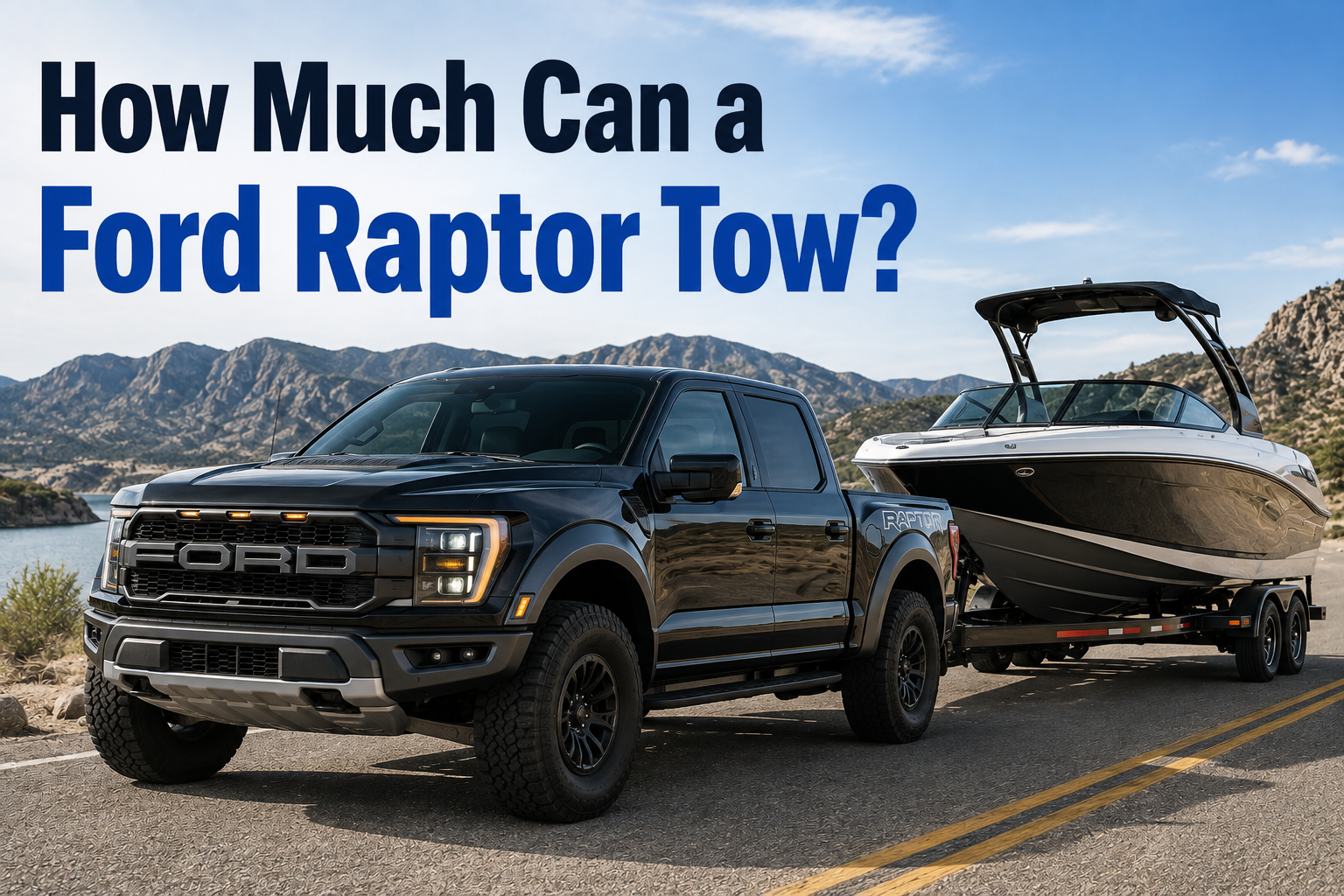
A Ford F-150 Raptor tows about 8,200 pounds when properly equipped. The hotter Raptor R, with its supercharged V8, is rated a little higher at 8,700 pounds. The smaller Ranger Raptor tows 5,510 pounds. So the answer depends on which Raptor you mean, but for the flagship F-150 Raptor, plan on roughly 8,200 pounds.
Those are strong numbers for a truck built to fly across the desert, but here is the honest part most spec sheets skip: a Raptor actually tows less than a regular work-spec F-150, and the real limit you will hit first is usually payload, not the tow rating. Below is the full breakdown by model and year, plus what these numbers mean once you hook up a real trailer.
The short answer by model and engine
First, sort out which Raptor you have. The name spans three different trucks today, and their ratings are far apart. This table covers the current models and the older F-150 Raptor generations.
| Raptor model | Engine | Max tow (approx.) |
| F-150 Raptor (2021–2025) | 3.5L HO EcoBoost V6 | 8,200 lbs |
| F-150 Raptor R (2023–2025) | 5.2L supercharged V8 | 8,700 lbs |
| Ranger Raptor (2024–2025) | 3.0L EcoBoost V6 | 5,510 lbs |
| F-150 Raptor (2017–2020) | 3.5L EcoBoost V6 | ~8,000 lbs |
| F-150 SVT Raptor (2010–2014) | 6.2L V8 | ~6,000 lbs |
A note on the exact F-150 Raptor figure: you will see it quoted as 8,200 or 8,300 pounds depending on the model year and source. Treat about 8,200 pounds as the working number and confirm your specific truck’s rating on the door-jamb sticker or in the Ford towing guide. Every figure here assumes the factory tow package and correct hitch.
The Raptor R’s extra 500 pounds over the standard Raptor comes from its beefier rear axle, stiffer springs, and a higher gross combined weight rating that Ford signed off on with the V8. In everyday terms, though, both F-150 Raptors pull a 6,000-pound trailer the same way. You will feel the supercharger long before you feel the 500-pound difference in rating.
Why a Raptor tows less than a normal F-150
This surprises people. A well-equipped standard F-150 can tow up to around 13,500 pounds, which is far more than any Raptor. The Raptor gives up that capability on purpose, because everything that makes it a desert-runner works against maximum towing.
Park a Raptor next to a max-tow F-150 and you can see it. The Raptor is wider, taller, and heavier. The long-travel Fox internal-bypass shocks, the wider track, the cast aluminum control arms, and the skid plates under the engine and transfer case all add curb weight. The suspension is tuned for soaking up whoops at speed, not for planting a heavy tongue weight. Every pound of that off-road hardware eats into the gap between the truck’s weight and what it can legally pull behind it.
So the Raptor is a deliberate trade. You get a truck that can do things almost nothing else on the road can, and in exchange you accept tow numbers that are good rather than class-leading. For most Raptor owners that trade makes complete sense, because they bought the truck to play, not to pull a fifth-wheel.
It is worth knowing how the number has moved over the years, since a lot of Raptors are on the used market. The original F-150 SVT Raptor, built from 2010 to 2014 with the 6.2L V8, was rated around 6,000 pounds. When Ford switched to the twin-turbo 3.5L EcoBoost V6 for the second and third generations, from 2017 onward, the rating climbed to roughly 8,000 pounds, and the current trucks sit near 8,200. So a newer Raptor tows meaningfully more than an early one, even though the early V8 trucks have their own following. If towing is part of why you are buying used, the EcoBoost-era trucks are the stronger choice on paper.
Payload is the real limit, not the tow rating
Here is the detail that matters more than the headline tow figure. The F-150 Raptor’s payload is only about 1,400 pounds. Payload is everything you put on the truck: passengers, cargo in the bed and cabin, and, crucially, the trailer’s tongue weight. On a conventional trailer, the tongue carries roughly 10 to 15 percent of the trailer’s total weight, and all of that lands on the truck’s payload.
Run the math and it gets tight fast. Say you are towing near the limit with a 6,000-pound trailer. At 12 percent tongue weight, that is about 720 pounds sitting on the hitch before anyone climbs in. Add four people and some gear, and you can blow past 1,400 pounds of payload while still being well under the tow rating. On these trucks you run out of payload long before you run out of pulling power.
The practical takeaway: do not just check the tow number. Check the yellow payload sticker on the driver’s door jamb, add up your people, your cargo, and your expected tongue weight, and make sure you are under that figure too. Both limits have to be respected at the same time, and on a Raptor payload is almost always the one that bites first.
This is also where a Raptor differs sharply from a work-focused F-150. A properly configured standard F-150 can carry well over 2,000 pounds of payload, sometimes over 3,000, which gives it huge headroom for tongue weight. The Raptor’s roughly 1,400 pounds is less than half that in the tallest cases, because the same off-road build that limits towing also eats into what the truck can carry. If you routinely tow near the limit with a full cab, that payload gap matters more than the tow rating on the brochure.
What you can comfortably tow with a Raptor
With those two limits in mind, here is what an F-150 Raptor handles well:
- A car trailer with a track toy or project car, up to around 6,000 pounds combined.
- A mid-size boat, such as a 20 to 22-foot bowrider or center console on its trailer.
- A pair of side-by-sides, ATVs, or dirt bikes on an enclosed or open trailer.
- A small to mid-size travel trailer, as long as the loaded weight and tongue weight stay within both limits.
The Ranger Raptor, at 5,510 pounds, covers a smaller slice: a light boat, a single small trailer, or a modest toy hauler. It is even more payload-limited than the F-150, so the same tongue-weight caution applies with less room to spare. If towing heavier loads is a regular need, a standard Ranger, which tows up to 7,500 pounds, or a work-spec F-150 is the better tool.
For genuinely heavy towing, a big travel trailer, a loaded car hauler, or a large boat, no Raptor is the right pick. Those loads want a properly equipped F-150 or a heavy-duty Super Duty. The Raptor’s gift is capability over rough ground, not maximum trailer weight.
Getting the most out of a Raptor’s tow rating
A few habits help you tow safely and use the capacity you have:
- Use the factory tow package and a hitch rated for your load. The Raptor’s Class IV hitch and smart trailer connector are built for this.
- Fit a trailer brake controller and use it. If your trailer is heavy, independent trailer brakes are usually required by law and always a good idea.
- Weigh the loaded trailer and measure tongue weight, rather than guessing. A public scale settles both in minutes.
- Use Tow/Haul mode, which changes the transmission’s shift behavior to hold gears longer and reduce hunting on grades.
- Distribute the trailer load with heavier items low and over the axle, balanced side to side, to keep the whole rig stable.
Do those, stay under both the tow and payload limits, and the Raptor is a stable, confident tow vehicle for the loads it is meant for. So, how much can a Ford Raptor tow? Around 8,200 pounds for the F-150 Raptor, 8,700 for the Raptor R, and 5,510 for the Ranger Raptor, with payload the number to watch most closely once you actually hitch up.
Frequently asked questions
How much can a Ford F-150 Raptor tow?
About 8,200 pounds when properly equipped, using the 3.5L high-output EcoBoost V6. Some model years and sources list it slightly higher at 8,300; confirm your truck’s exact rating on the door-jamb sticker.
How much can a Raptor R tow?
Up to 8,700 pounds, about 500 pounds more than the standard Raptor. The gain comes from a stronger rear axle, stiffer springs, and a higher gross combined weight rating paired with the supercharged V8.
How much can a Ranger Raptor tow?
5,510 pounds, notably less than a standard Ranger’s 7,500-pound rating. The off-road suspension setup lowers its towing and payload figures compared with the regular Ranger.
Why does a Raptor tow less than a regular F-150?
The Raptor’s heavy off-road hardware, long-travel suspension, wider track, and skid plates add curb weight and are tuned for speed over rough terrain, not maximum trailer weight. A work-spec F-150 can tow up to around 13,500 pounds.
What limits a Raptor’s towing in real life?
Payload, not the tow rating. With only about 1,400 pounds of payload, the trailer’s tongue weight plus passengers and cargo often reach the limit before you approach the maximum tow figure. Always check the door-jamb payload sticker.
Related Articles
Did Ford Buy Ferrari? The Real Story Behind the Failed 1963 Deal
Did Ford Discontinue the Edge? Reasons & Alternatives Explained