





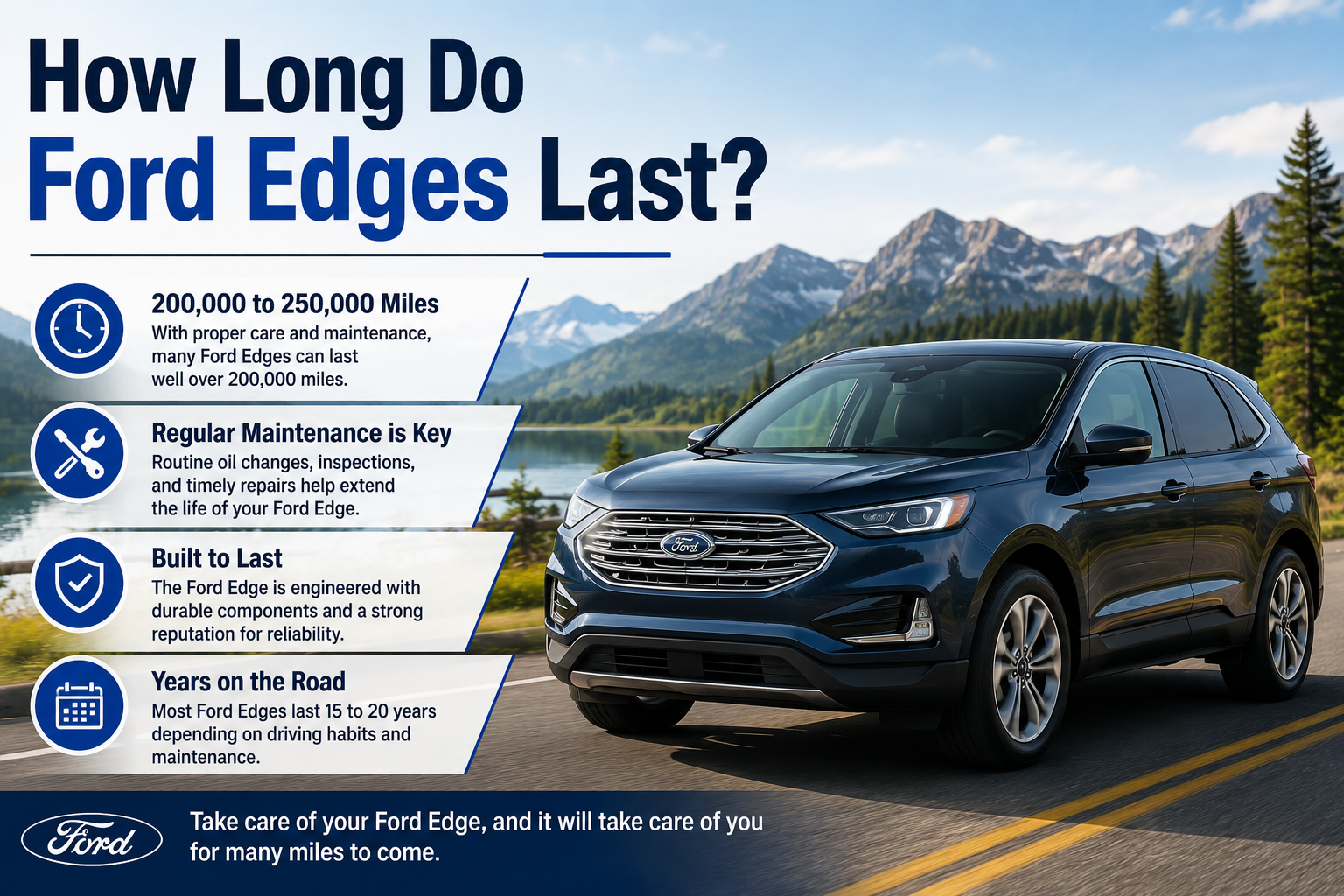
A Ford Edge lasts around 155,000 miles on average, which works out to roughly 11 to 12 years at typical driving distances. That is the middle of the pack. With consistent maintenance, plenty of Edges go much further, and it is common to see well-kept examples pass 200,000 miles. Large-scale data puts the odds of an Edge reaching 200,000 miles at about one in five, so a long life is achievable but not automatic.
The short version: a well-cared-for Edge is a dependable midsize SUV that will serve a family for a decade or more. The number you actually reach depends far more on maintenance, driving habits, and which model year you own than on the badge itself. Here is what shapes that lifespan, which years hold up best, and how to push your own Edge toward the high-mileage end of the range.
The average lifespan, and what’s realistic
Analysis of hundreds of millions of vehicles puts the Ford Edge’s average lifespan at about 155,000 miles, or roughly 11.5 years given the typical 12,000 miles a year that owners drive. That earns the Edge a reliability score around 7.3 out of 10 and a ranking near the top third of crossover SUVs, which is a solidly above-average result.
Averages hide a wide spread, though. The same data shows about a one-in-five chance of an Edge reaching 200,000 miles, and owner reports are full of examples that cleared that mark on original engines and transmissions. On the other end, a neglected Edge, or one of the weaker early model years, can start needing serious repairs well before 150,000 miles. The gap between those two outcomes is mostly about care and choice of year, which is good news, because both are in your control.
For a sense of scale, the Edge lands close to rivals like the Chevrolet Equinox and holds up well against a Honda Pilot on paper, though long-lived Pilots are easier to find simply because that model has been around longer. In its own class, the Edge is a reasonable bet for long service, not a standout in either direction.
It also helps to separate two different questions people mix together: how long the Edge lasts, and how much it costs to keep running along the way. The Edge does well on the first and is roughly average on the second. Annual repair and maintenance runs a little above the midsize-SUV norm, but nothing about the truck is unusually fragile or expensive once you are past the weaker early years. A high-mileage Edge is less a gamble and more a reflection of how its previous owner treated it, which is exactly why service records matter so much on this model.
What decides how long an Edge lasts?
Three things move the needle more than anything else:
- Maintenance consistency. Regular oil changes, fluid services, and inspections are the single biggest factor. Small issues caught early stay cheap; ignored, they cascade into engine and transmission damage that ends a vehicle’s life early.
- Driving style. Smooth acceleration and gentle braking put far less stress on the powertrain than hard, aggressive driving. Lots of short trips and heavy stop-and-go wear a vehicle faster than steady highway miles.
- Climate and conditions. Extreme heat, deep cold, and road salt all speed up wear. The Edge resists rust reasonably well, with corrosion tending to show at door seams rather than eating through panels, but salt-belt cars still need underbody care.
Notice what is not on that list: luck. A high-mileage Edge is almost always one that got its fluids changed on time and was driven with some mechanical sympathy. That is the recipe, and it is not complicated.
The best and worst Edge years for longevity
Because the Edge is now a used-market vehicle, the model year you buy matters a lot. Reliability varied sharply across its run, and picking a strong year is one of the easiest ways to land a long-lasting truck. This table sums it up:
| Model years | Rating | What to know |
| 2007–2008 | Weak | Early transmission and brake trouble; be cautious |
| 2009, 2014 | Better | The stronger picks from the first generation |
| 2011–2013 | Weakest | 2013 is the most complained-about year; avoid |
| 2015 (early) | Mixed | First year of gen two; some engine and tech bugs |
| 2018–2024 | Strong | The most refined, longest-lasting Edges to buy |
The first-generation cars from 2007 and 2008 struggled with transmission and brake problems, sometimes serious enough that the transmission would act up without warning. The 2011 through 2013 stretch is the weakest of all, with 2013 drawing the most owner complaints of any Edge year, covering transmission slipping and hesitation, engine stalling, brake wear, and a persistent door-ajar warning light that would flag a closed door. Repair costs on those years ran noticeably higher than average.
The bright spots in the first generation are 2009 and 2014, which avoided most of the worst issues. The second generation launched in 2015 and, like many first-year designs, carried some engine and infotainment bugs early on. From roughly 2018 onward the Edge settled into its most refined, dependable form, and those later years, through the final 2024 model, are the ones most likely to reach high mileage with the fewest headaches. If longevity is your priority, shop the later cars first.
There is a practical reason the later years matter beyond just fewer complaints. Ford kept refining the engines, transmission calibration, and electronics across the second generation, so a 2020 or 2022 Edge benefits from years of quiet fixes that the 2015 never got. It is the same reason the final model years of most vehicles tend to be the most sorted: the design has had time to mature. When you cross-shop used Edges, a slightly newer car in the strong-year range is often worth the extra money purely for the longer, calmer road ahead.
How long the major components last?
Lifespan is really the sum of its parts. Here is what to expect from the Edge’s wear items, so you can budget and plan rather than be surprised:
- Transmission: with regular fluid service, the Edge’s transmission can last the life of the vehicle. Skipped maintenance is what turns it into an early, expensive failure, especially on the weaker year groups.
- Brakes: pads and rotors typically last somewhere between 60,000 and 100,000 miles, depending heavily on how you drive. City driving and hard braking shorten that range.
- Battery: expect roughly three to six years. Heavy short-trip use or extreme climates land you at the shorter end.
- Tires: the original tires often last several years and tens of thousands of miles, with rotation and alignment making a real difference.
- Suspension: past about 80,000 miles, worn strut mounts, sway bar links, and control arm bushings can bring clunks or loose steering. These are routine, affordable fixes that keep the truck feeling tight.
None of these are unusual for a midsize SUV. Budgeting around $600 a year for maintenance and repairs is a fair planning figure for the Edge, a touch above the midsize-SUV average but not dramatically so.
How to make your Ford Edge last longer?
Reaching 200,000 miles is realistic if you treat the Edge well. The habits that get you there are simple and consistent:
- Change the oil on schedule, and do not stretch the interval. Clean oil is the cheapest insurance the engine has.
- Service the transmission fluid at the recommended interval. This is the maintenance most owners skip and most often regret, since it protects the component most likely to end the vehicle’s life.
- Address warning lights and small noises promptly instead of waiting. A cheap fix now usually prevents an expensive one later.
- Keep up with brakes, tires, and suspension wear items so problems do not compound into bigger ones.
- In salt regions, wash the underbody through winter and keep an eye on the door seams and undercarriage for corrosion.
Do those things and the Edge rewards you. So, how long do Ford Edges last? Plan on around 155,000 miles as a baseline, treat 200,000-plus as very reachable with good care, and stack the odds in your favor by choosing a later, stronger model year. For a family that keeps up with maintenance, a well-chosen Edge is a genuinely long-lasting SUV.
Frequently asked questions
How many miles is high mileage for a Ford Edge?
Around 155,000 miles is the average lifespan, so anything past that counts as high mileage. A well-maintained Edge can still run reliably well beyond 200,000 miles, so high mileage alone is not a dealbreaker on a car with good service history.
Can a Ford Edge last 200,000 miles?
Yes. About one in five Edges reaches 200,000 miles, and consistent maintenance greatly improves those odds. Regular oil and transmission service are the biggest factors in getting there.
Which Ford Edge years last the longest?
The later second-generation models, roughly 2018 through 2024, along with the 2009 and 2014 first-generation cars, are the most dependable. The 2011 to 2013 years are the ones to avoid for longevity.
Is the Ford Edge reliable?
Overall, yes. It rates above average for a midsize SUV, with reliability scores around 7.3 out of 10 and 3.5 out of 5 from major sources. Reliability does vary a lot by model year, so choosing wisely matters.
What usually fails first on a Ford Edge?
Brakes and suspension wear items show up first as normal maintenance. The costlier risks are transmission trouble on neglected or early-year cars and electrical quirks like the door-ajar light on some first-generation models.
Related Articles
Did Ford Discontinue the Edge? Reasons & Alternatives Explained
What Does XLT Stand For on a Ford? Complete Trim Level Guide
Does Ford Own Jaguar Land Rover? The Complete Ownership History Explained
Is Ford Escape A Good Car? Complete Reliability, Performance & Buyer’s Guide