


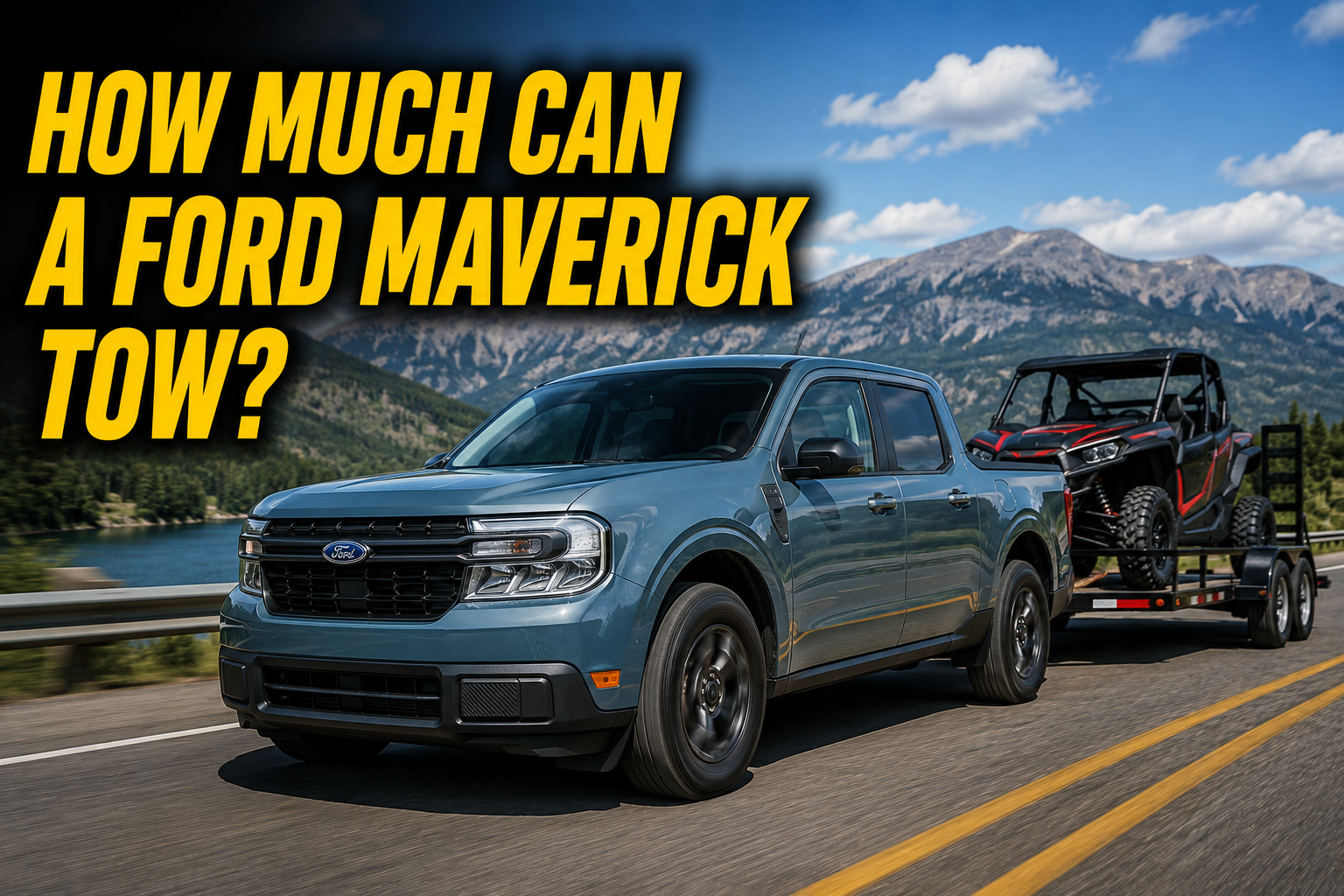
If you are asking how much can a Ford Maverick tow, the simple answer is this: the base Maverick without any towing equipment can tow up to 2,000 pounds, while a properly equipped EcoBoost Maverick with the Tow Package can pull up to 4,000 pounds.
The hybrid version stays closer to the 2,000 pound mark even with the package added. This makes the Maverick a solid choice for light-duty towing needs rather than heavy hauling jobs. Below, we will break down every trim, engine option, and real-world towing scenario so you know exactly what this compact truck can handle before you hook up a trailer.
Ford Maverick Towing Capacity by Trim and Engine
The towing number for a Maverick depends heavily on which engine and drivetrain you choose, since Ford offers different setups across the lineup. Understanding these differences helps you pick the right configuration for your specific towing needs.
Base 2.0L EcoBoost Without Tow Package
The standard front-wheel-drive Maverick equipped with the turbocharged EcoBoost engine but without any added towing hardware is rated to tow around 2,000 pounds.
This is enough for a small utility trailer or a couple of jet skis, but not much beyond that. Owners who plan to tow occasionally and lightly often find this base rating sufficient for their needs.
2.0L EcoBoost With Tow Package
Once the optional Tow Package is added to the EcoBoost engine, the towing rating jumps significantly to 4,000 pounds. This package includes hardware upgrades that allow the truck to handle heavier loads safely over longer distances.
It is the most popular choice among buyers who genuinely plan to tow trailers, campers, or boats on a regular basis.
2.5L Hybrid Engine Towing Limits
The hybrid Maverick, while excellent on fuel economy, has more restrictive towing limits due to its battery placement and cooling requirements. Most hybrid configurations top out around 2,000 pounds even when the Tow Package is selected. Buyers who prioritize towing capacity over fuel savings may want to reconsider the hybrid option.
AWD Versus FWD Towing Differences
All-wheel-drive Maverick models generally offer slightly better stability while towing, though the maximum weight rating does not change dramatically compared to front-wheel-drive versions.
The AWD system helps with traction on wet roads or inclines when pulling a loaded trailer. However, the towing ceiling is still governed primarily by the engine and Tow Package combination rather than the drivetrain layout.
Year by Year Changes Across Model Years
Since its 2022 launch, the Maverick’s towing figures have remained fairly consistent across model years, with only minor adjustments in later trims. Ford has kept the 2,000 and 4,000 pound benchmarks largely unchanged through the 2023, 2024, 2025, and 2026 model years. Buyers should still confirm exact figures for their specific model year, as small trim-level tweaks can occur.
What Comes With the Tow Package
The Tow Package is not just a sticker on the truck; it includes real mechanical upgrades that make higher towing weights possible. Without it, attempting to tow near the maximum rated weight is not recommended or safe.
Class II or III Hitch Receiver
The package includes a proper hitch receiver rated for the higher towing capacity, replacing the lighter-duty hardware found on base models.
This ensures the connection point between the truck and trailer can handle the added stress. A correctly rated hitch is essential for both safety and legal compliance in most regions.
Upgraded Engine Cooling System
Towing generates significant extra heat, so the package adds a larger radiator and improved cooling components to prevent the engine from overheating under load.
This upgrade is particularly important during long highway drives with a loaded trailer attached. Without it, the base cooling system would struggle during sustained heavy pulls.
Trailer Wiring Harness
A factory-installed wiring harness is included so trailer lights, brakes, and signals can be connected without aftermarket modifications.
This makes hooking up most standard trailers straightforward and safer, since all lighting is synced properly. It also helps maintain compliance with road safety regulations regarding trailer visibility.
Transmission Cooling Support
Depending on the specific configuration, the package may also include additional transmission cooling to handle the extra strain of pulling heavier loads. This helps extend the lifespan of the transmission under repeated towing use. It is a smaller but still valuable part of the overall package.
Cost of Adding the Tow Package
The Tow Package is typically offered as a relatively affordable option compared to the jump in capability it provides. Pricing can vary by dealership and model year, so it is worth checking current listings before purchase. For most buyers planning any regular towing, the cost is well justified by the doubled capacity it unlocks.
Payload Capacity and How It Affects Towing
Towing capacity and payload capacity are related but different numbers, and understanding both is necessary to use the Maverick safely and legally.
Maverick Payload Ratings
Payload refers to the total weight the truck bed and cabin can carry, including passengers, cargo, and tongue weight from a trailer.
Maverick payload ratings generally range from around 1,500 pounds and can vary by trim and engine choice. Exceeding payload limits can affect handling and braking even if the trailer itself is within its towing limit.
Difference Between Towing and Payload
Towing capacity measures how much weight the truck can pull behind it, while payload measures how much weight it can carry internally, including in the bed.
Both numbers interact because tongue weight from a trailer counts against payload, not just the towing figure. Ignoring this relationship is a common mistake that can lead to overloading the vehicle.
Combined Weight Limits Explained
Gross Combined Weight Rating, or GCWR, represents the maximum total weight of the truck, passengers, cargo, and trailer combined.
Staying under this number is just as important as staying under the towing capacity alone. Overlooking GCWR is one of the most overlooked safety issues among first-time trailer owners.
Real World Towing Examples
Numbers on paper are useful, but seeing how those numbers translate to actual towing scenarios makes the picture clearer for everyday buyers.
Towing a Small Camper or Teardrop Trailer
Lightweight teardrop trailers and small campers typically weigh between 1,500 and 3,500 pounds, placing them comfortably within the Maverick’s towing range when equipped properly.
This makes the Maverick a popular choice among weekend campers who want a compact and fuel-efficient tow vehicle. Larger travel trailers, however, would exceed its safe limits.
Towing a Boat
Small aluminum fishing boats or personal watercraft trailers generally fall well under the 4,000 pound mark, making them an easy match for an EcoBoost Maverick with the Tow Package.
Larger fiberglass boats or pontoon trailers, on the other hand, often exceed what the Maverick can safely handle. Buyers should always weigh their specific boat and trailer combination before assuming it will fit within limits.
Towing a Car or ATV Trailer
A single ATV or small utility trailer carrying light equipment typically stays within the Maverick’s towing range without issue.
Attempting to tow a car hauler with a full-size vehicle loaded on it, however, would likely exceed the truck’s rated capacity. It is important to weigh the combined trailer and cargo weight rather than estimating.
Towing a Horse Trailer
Horse trailers, even small ones, often weigh well beyond 4,000 pounds once animals and equipment are loaded inside. This places horse trailers outside the safe towing range for any Maverick configuration. Buyers with horse trailering needs should look toward larger trucks better suited for that weight class.
How Maverick Towing Compares to Competitors
Looking at how the Maverick stacks up against similar vehicles helps put its towing numbers into perspective for shoppers comparing options.
| Vehicle | Max Towing Capacity |
| Ford Maverick (EcoBoost + Tow Package) | 4,000 lbs |
| Hyundai Santa Cruz | 5,000 lbs |
| Ford Ranger | 7,500 lbs |
| Toyota Tacoma | 6,800 lbs |
| Nissan Frontier | 6,720 lbs |
The Hyundai Santa Cruz, the Maverick’s closest direct competitor, generally offers a slightly higher towing ceiling depending on trim. Mid-size trucks like the Ranger, Tacoma, and
Frontier are built for heavier-duty work and outclass the Maverick significantly in raw towing numbers. However, the Maverick remains more affordable and fuel-efficient, making it appealing for buyers who do not need maximum towing muscle.
Tips for Safe and Efficient Towing
Getting the most out of the Maverick’s towing capability requires more than just staying under the weight limit; proper technique matters as well.
Weight Distribution Basics
Distributing weight evenly across the trailer, with slightly more toward the front, helps maintain stability while towing. Uneven loads can cause swaying, especially at highway speeds. Taking time to load a trailer correctly reduces strain on both the truck and the hitch system.
Tire Pressure and Suspension Considerations
Checking and adjusting tire pressure before towing helps the Maverick maintain better control and handling under load. Some owners also consider aftermarket suspension upgrades for frequent towing use. Proper tire condition is especially important since towing puts extra stress on tread wear.
Braking Distance With a Trailer
Towing any load increases stopping distance, so drivers should leave extra following room and reduce speed compared to unloaded driving. This is true even within the Maverick’s rated towing limits. Trailer brakes, where applicable, should always be tested before longer trips.
Fuel Economy Impact While Towing
Towing near the Maverick’s maximum capacity will noticeably reduce fuel economy compared to normal driving conditions.
This is expected across nearly all vehicles and should be factored into trip planning. Hybrid models in particular may see a larger relative drop due to how the electric assist system operates under heavy load.
Frequently Asked Questions
Does the hybrid Maverick tow less than the EcoBoost?
Yes, the hybrid generally maxes out around 2,000 pounds even with the Tow Package, while the EcoBoost can reach 4,000 pounds.
Can I add the Tow Package after purchase?
It is best selected at the time of purchase since it involves factory hardware; aftermarket additions may not fully match factory ratings.
What is the smallest camper the Maverick can tow?
Teardrop trailers and small campers under 3,500 pounds are generally well suited to a properly equipped Maverick.
Is the Maverick good for occasional light towing?
Yes, for light and occasional towing needs like small trailers or personal watercraft, the Maverick performs reliably well.
Conclusion
So, how much can a Ford Maverick tow overall? The answer ranges from 2,000 pounds on base configurations up to 4,000 pounds with the EcoBoost engine and Tow Package combined, while hybrid models stay closer to the lower end.
It comfortably handles small campers, boats, and utility trailers, though it falls short of mid-size trucks and even some competitors like the Santa Cruz for heavier hauling needs. For buyers who want an efficient, compact truck with dependable light-duty towing ability, the Maverick remains a strong and practical choice.
Related Articles
How Much Does a Ford F150 Weigh? Full Weight Guide by Trim, Cab & Engine
What Is The Towing Capacity Of A Ford F150? Full 2026 Guide
How Much Does a Ford Raptor Cost in 2026? Full Price Breakdown
Are Ford Broncos Safe? Complete Safety Ratings & Features Guide 2026
What Does ST Stand For Ford? Complete Guide to Ford’s Performance Badge Explained