






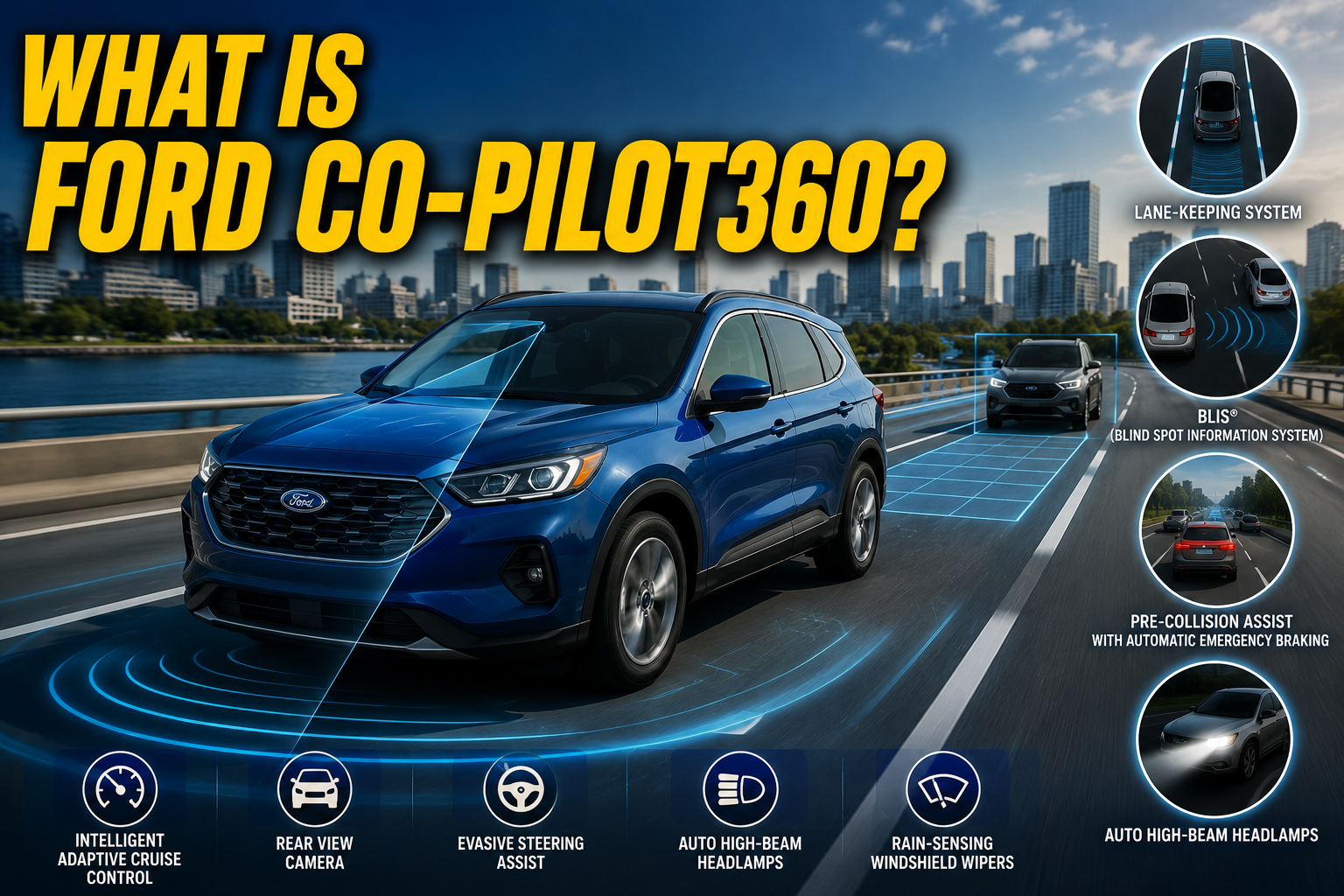
Ford Co-Pilot360 is a collection of driver-assist and safety technologies that Ford builds into its vehicles to make everyday driving safer and easier. It uses cameras, radar, and sensors to watch the road, warn drivers of danger, and in some cases even act automatically to prevent accidents.
Whether you are a new driver or someone who drives long distances daily, understanding what is Ford Co-Pilot360 helps you make a smarter choice when buying your next vehicle.
What Is Ford Co-Pilot360 in Simple Words
At its core, Ford Co-Pilot360 is a bundle of driver-assistance features rather than a single gadget or button. It combines multiple technologies that work together in the background, constantly checking blind spots, upcoming traffic, and lane position so the driver does not have to rely on instinct alone.
Why Ford Introduced This Safety Suite
Ford introduced this suite because road accidents caused by human error remain one of the leading safety concerns worldwide. Instead of leaving safety entirely to the driver’s reflexes, Ford wanted a system that adds an extra layer of protection during ordinary daily driving.
Who This Technology Is Designed For
Co-Pilot360 is designed for a wide range of drivers, from beginners still building confidence on the road to experienced drivers who want reduced mental fatigue during long commutes. Families also benefit heavily since the system reduces the chances of avoidable collisions in busy traffic.
The History Behind Co-Pilot360
Ford’s approach to safety did not appear overnight; it developed gradually as sensor and camera technology became more affordable and reliable for mass-market vehicles.
When Ford Launched Co-Pilot360
Ford rolled out Co-Pilot360 in the late 2010s as part of its plan to make advanced safety features standard rather than expensive add-ons. Over time, the company expanded the suite across nearly its entire vehicle lineup, from compact cars to trucks and SUVs.
Evolution From Basic Safety to Advanced Assistance
Earlier Ford vehicles relied on simple mechanical safety features like seatbelts and airbags. Co-Pilot360 marked a shift toward active safety, where the car itself monitors surroundings in real time and reacts before a human driver even notices a risk.
Ford’s Vision for Smarter, Safer Driving
Ford’s long-term vision centers on gradually increasing vehicle intelligence without removing the driver from control. Co-Pilot360 is a stepping stone in that direction, blending automation with driver responsibility rather than replacing it entirely.
Core Features of Ford Co-Pilot360
The heart of Co-Pilot360 lies in its individual features, each targeting a specific everyday driving risk such as sudden braking situations, blind spots, or lane drifting.
Pre-Collision Assist With Automatic Emergency Braking
This feature continuously scans the road ahead using radar and camera sensors. If it detects a vehicle stopping suddenly or an obstacle appearing unexpectedly, it warns the driver and can apply the brakes automatically if there is no response in time.
Pedestrian Detection
Working alongside Pre-Collision Assist, this feature specifically looks for pedestrians who may step into the vehicle’s path. It is especially useful in crowded city streets, school zones, and parking areas where sudden pedestrian movement is common.
Blind Spot Information System (BLIS)
BLIS monitors the areas beside and slightly behind the vehicle that mirrors typically cannot cover. When another vehicle enters this blind zone, the system alerts the driver visually, helping prevent dangerous lane-change collisions.
Cross-Traffic Alert
This feature becomes especially useful while reversing out of parking spots or driveways. It detects vehicles approaching from either side that the driver may not notice and issues a timely warning to avoid a collision.
Lane-Keeping System
The Lane-Keeping System includes both a warning function and a gentle steering correction function. If the vehicle begins drifting out of its lane without a turn signal, it first alerts the driver and then nudges the steering back if needed.
Auto High-Beam Headlamps
This feature automatically switches between high and low beam headlights based on surrounding traffic. It improves night visibility while avoiding the risk of blinding oncoming drivers, removing one more manual task from the driver.
Rear View Camera
A standard component in most Co-Pilot360-equipped vehicles, the rear view camera provides a clear visual of what is directly behind the car, making reversing safer, especially in tight spaces or crowded parking lots.
Rear Parking Sensors
On select trims, rear parking sensors add an audible alert system that beeps faster as the vehicle gets closer to an object while reversing, giving drivers extra confidence during parking maneuvers.
Advanced Versions of Co-Pilot360
Beyond the base package, Ford offers upgraded tiers that add more sophisticated automation for drivers who want extra convenience on highways and in parking situations.
Co-Pilot360 Assist
This tier typically bundles the core features into a more complete highway-ready package, often including adaptive cruise control that automatically adjusts vehicle speed based on the car ahead.
Co-Pilot360 Assist+
Assist+ builds further by adding features like evasive steering assist, which helps the driver steer around an obstacle if braking alone would not avoid a collision, along with enhanced lane-centering support.
Co-Pilot360 Active Park Assist
This version focuses entirely on parking convenience, allowing the vehicle to automatically steer itself into parallel or perpendicular parking spots while the driver controls the pedals.
Differences Between Each Tier Explained Simply
| Tier | Focus Area | Key Addition |
| Co-Pilot360 (Base) | Everyday city driving safety | Collision and lane alerts |
| Co-Pilot360 Assist | Highway driving comfort | Adaptive cruise control |
| Co-Pilot360 Assist+ | Advanced driving support | Evasive steering assist |
| Active Park Assist | Parking convenience | Automated steering while parking |
How Co-Pilot360 Works in Simple Terms
Understanding the technology behind Co-Pilot360 helps drivers trust it more and use it effectively rather than treating it as a mysterious black box.
Sensors, Cameras, and Radar Explained
The system relies on a combination of forward-facing cameras, radar units, and ultrasonic sensors placed around the vehicle. Each component covers a different zone, from directly ahead to the sides and rear, creating a nearly complete picture of the car’s surroundings.
How the System Sees the Road
These sensors feed information into onboard computers that process the data almost instantly. The vehicle essentially builds a live map of nearby objects, vehicles, and pedestrians, comparing their movement patterns against potential collision paths.
Real-Time Alerts and Automatic Responses
Depending on the severity of a detected risk, the system responds in stages: a visual alert first, followed by an audible warning, and finally an automatic action such as braking or steering correction if the driver does not react quickly enough.
Benefits of Ford Co-Pilot360
The real value of this safety suite becomes clear when looking at how it changes the everyday driving experience for the better.
Improved Safety for Drivers and Passengers
By constantly monitoring the road, Co-Pilot360 reduces the reliance on split-second human judgment, which is often the weakest link in accident prevention.
Reduced Risk of Accidents
Features like automatic emergency braking and blind spot monitoring directly target the most common causes of everyday collisions, from rear-end crashes to lane-change accidents.
Easier Parking and Maneuvering
With rear cameras, parking sensors, and Active Park Assist, tight parking spaces become far less stressful, particularly for drivers who are less confident with spatial judgment.
Peace of Mind for New or Nervous Drivers
New drivers often feel anxious about blind spots and sudden braking situations. Co-Pilot360 acts as a safety net, catching mistakes before they turn into accidents.
Insurance Considerations
Many insurance providers view vehicles equipped with advanced safety systems favorably, since these technologies statistically reduce accident frequency and severity, though specific discounts vary by provider and region.
Which Ford Models Include Co-Pilot360
Understanding availability helps buyers know what to expect when comparing different Ford trims and models.
Standard vs Optional Availability
In many newer Ford models, the base Co-Pilot360 package comes as standard equipment, while higher tiers like Assist+ or Active Park Assist are offered as optional upgrades or bundled into premium trims.
Popular Models Featuring This Technology
Vehicles such as the Ford Explorer, Ford Escape, Ford F-150, and Ford Mustang Mach-E commonly include Co-Pilot360 as part of their safety offering, reflecting Ford’s push to make it widely accessible.
Trim-Level Differences
Entry-level trims usually include the core features, while mid and top-tier trims unlock additional functions like adaptive cruise control and automated parking, so it is worth checking trim specifications carefully before purchase.
Co-Pilot360 vs Other Brands’ Driver-Assist Systems
No safety suite exists in isolation, and comparing it with competitors helps highlight what makes Ford’s approach distinct.
Comparison With Toyota Safety Sense and Honda Sensing
Toyota Safety Sense and Honda Sensing offer similar core functions such as collision warnings and lane-keeping assistance. Ford Co-Pilot360 generally matches these in core safety coverage but is often praised for smoother integration of parking assistance across a wider range of models.
What Makes Ford’s System Unique
Ford’s advantage lies in offering tiered packages that scale from basic city safety to advanced highway and parking automation, giving buyers flexibility based on their driving needs and budget rather than a single fixed package.
Common Myths and Misunderstandings
Despite its growing popularity, several misconceptions about Co-Pilot360 persist among car buyers.
Is It Fully Self-Driving
Co-Pilot360 is not a self-driving system. It assists the driver by monitoring surroundings and intervening in specific risk situations, but full attention and control still rest with the person behind the wheel.
Does It Replace Safe Driving Habits
The system is designed to support good driving habits, not replace them. Drivers should still check mirrors, signal properly, and stay alert, treating Co-Pilot360 as a backup rather than a substitute for attentive driving.
Tips for Using Co-Pilot360 Effectively
Getting the most out of this safety suite requires a basic understanding of how to manage its settings and upkeep.
How to Enable or Disable Features
Most Co-Pilot360 features can be toggled through the vehicle’s central display settings menu, allowing drivers to adjust sensitivity levels or turn off specific alerts if they find them overly cautious in certain driving conditions.
Maintenance Tips for Sensors and Cameras
Since the system depends heavily on cameras and sensors, keeping the windshield, grille, and bumper areas clean and free of dirt or ice ensures the technology continues working accurately, especially during winter months.
Getting the Most Out of the System
Drivers are encouraged to read the vehicle manual thoroughly and spend time familiarizing themselves with alert sounds and warning patterns, so they can respond quickly and confidently when the system activates.
Future of Ford’s Driver-Assist Technology
Ford continues to invest in refining its safety technology as sensor accuracy and computing power improve year after year.
Upcoming Updates or Improvements
Future updates are expected to bring sharper object detection, improved performance in poor weather conditions, and better integration with connected vehicle features for real-time traffic and hazard data.
Ford’s Roadmap Toward More Advanced Automation
While Ford is not aiming for fully autonomous vehicles in the near term, the company is steadily expanding semi-autonomous capabilities, building on the foundation that Co-Pilot360 has already established.
Conclusion
Understanding what is Ford Co-Pilot360 comes down to recognizing it as a thoughtfully layered safety suite rather than a single feature.
From collision prevention to easier parking, it addresses the everyday risks that drivers face without taking full control away from them. As Ford continues refining this technology, it remains a strong reason why safety-conscious buyers consider Ford vehicles a reliable choice.
FAQs
Is Ford Co-Pilot360 available on all Ford models?
Most modern Ford models include at least the base Co-Pilot360 package, though advanced tiers may only be available on select trims.
Does Co-Pilot360 work in bad weather?
The system generally performs well but can be less reliable in heavy rain, snow, or fog, since sensors depend on clear visibility.
Can I turn off Co-Pilot360 features?
Yes, most individual features can be adjusted or disabled through the vehicle’s settings menu based on driver preference.
Is Active Park Assist available on every model?
No, it is typically offered as an optional feature on select trims rather than included universally.
Does Co-Pilot360 replace the need for driver attention?
No, it is designed to assist attentive driving, not replace the driver’s responsibility on the road.
Related Articles
What Does ST Stand For Ford? Complete Guide to Ford’s Performance Badge Explained
How Long Do Ford Escapes Last? Complete Lifespan, Mileage & Reliability Guide
Is The Ford Escape A Good Vehicle? Full Honest Review 2026
How Much Can a Ford Maverick Tow?
What Is the Ford EcoBoost Engine? A Complete Guide to How It Works