




Introduction
Few questions spark as much debate among car buyers as “is Ford American made?” It seems like it should have a simple yes or no answer, but the reality is far more layered. Ford is one of the most recognizable American brands in the world, yet the vehicles rolling off its assembly lines today are the product of a global supply chain that spans several countries.
This question matters to a lot of people for reasons that go beyond simple curiosity. Some buyers want to support American jobs and the domestic economy. Others associate “Made in USA” with a certain standard of quality or national pride. And some are simply doing research before a major purchase and want to know exactly what they are paying for.
The short answer is this: Ford is an American company through and through, but not every Ford vehicle is built entirely on American soil, and even the ones assembled in the United States are made using parts sourced from around the world. Let’s break down exactly what that means.
Ford’s American Roots
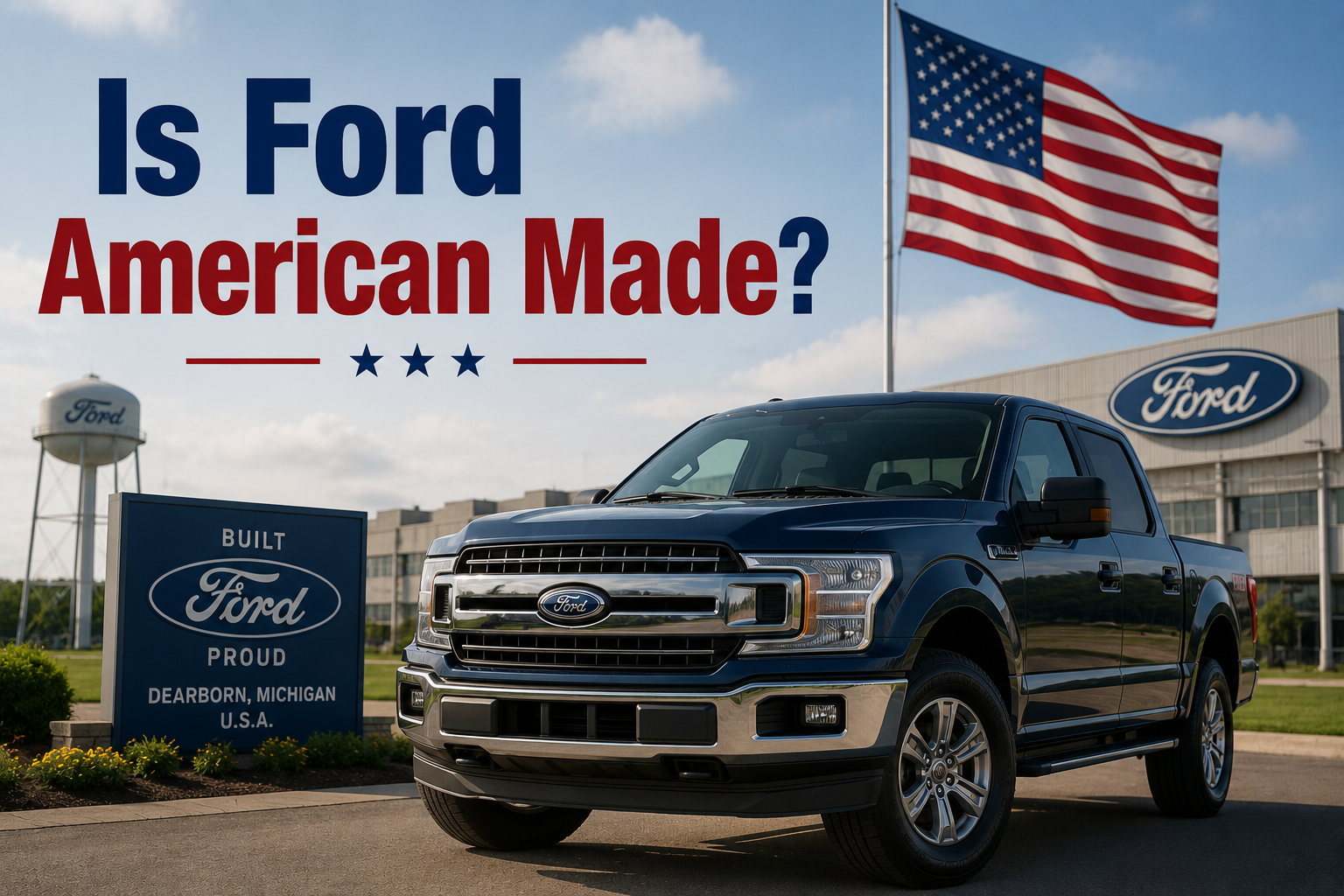
Ford Motor Company was founded by Henry Ford in 1903 in Dearborn, Michigan, a city that remains the company’s global headquarters to this day. Few brands are as tied to American industrial history as Ford. The company pioneered the moving assembly line, which transformed manufacturing not just for cars but for entire industries worldwide, and it played a major role in shaping Detroit into the automotive capital of the world.
Over the past century, Ford has grown from a small workshop into a multinational corporation with operations, factories, and dealerships across the globe. Despite this global expansion, its leadership, headquarters, and corporate identity remain firmly rooted in the United States. When people ask “is Ford American made,” part of what they are really asking is whether that founding identity still holds true in an era of global manufacturing, and the answer is a nuanced yes.
What “American Made” Actually Means
Before diving deeper, it helps to understand what the phrase “Made in America” legally and practically means, because it is not as straightforward as it sounds.
The Federal Trade Commission (FTC) has strict guidelines for any company that wants to label a product as “Made in USA.” According to these rules, a product must be “all or virtually all” made in the United States, meaning nearly every component and the manufacturing process itself must happen domestically. This is a much higher bar than most people assume.
Because of this, there is an important difference between a few commonly confused terms:
- Assembled in USA: The final assembly of the vehicle happens in an American factory, but individual parts may come from other countries.
- Made in USA: Nearly all parts and labor are domestic, meeting the FTC’s strict threshold.
- American brand: The company is headquartered and founded in the United States, regardless of where manufacturing occurs.
In today’s automotive industry, almost no vehicle is built entirely within one country’s borders. Engines might be manufactured in one country, transmissions in another, electronics in a third, and final assembly in a fourth. This is simply how modern car manufacturing works, and Ford is no exception.
Where Ford Vehicles Are Actually Built
Ford operates a large network of manufacturing plants, and while a majority of its vehicles for the American market are assembled in the United States, the company also has significant operations in Mexico and Canada.
In the United States, Ford runs major assembly plants in states including Michigan, Ohio, Kentucky, and Missouri. These plants are responsible for producing some of Ford’s best-selling and most iconic vehicles, providing thousands of manufacturing jobs across the country.
At the same time, Ford also operates plants in Mexico, where certain models and components are produced, largely due to cost efficiency and long-standing trade agreements. Similarly, Ford has a manufacturing presence in Canada, which has historically been an important part of the North American auto industry alongside the US and Mexico.
This tri-country manufacturing web means that when someone asks “is Ford American made,” the honest answer depends heavily on which specific model or even which specific vehicle they are asking about.
Model-by-Model Breakdown
Different Ford models are built in different locations, and this can change from year to year as production shifts based on demand, cost, and strategy. Below is a general overview of where some of Ford’s most popular models have typically been assembled.
| Ford Model | Primary Assembly Location | Notes |
|---|---|---|
| F-150 | United States (Michigan, Missouri) | Ford’s best-selling truck, largely built domestically |
| Mustang | United States (Michigan) | Iconic sports car assembled in the US |
| Explorer | United States (Illinois) | Popular SUV built domestically |
| Bronco | United States (Michigan) | Off-road SUV assembled domestically |
| Escape | United States and other North American plants | Production has shifted between locations over the years |
| Ford Fusion (discontinued) | Mexico | Historically built in Mexico before discontinuation |
| Ford Maverick | Mexico | Compact pickup assembled in Mexico |
It’s worth noting that production locations can shift over time due to factory retooling, model updates, or changes in company strategy, so it’s always a good idea to check the specific vehicle you are interested in rather than relying on general assumptions about the brand as a whole.
Parts Sourcing: The Hidden Layer
Even when a Ford vehicle is assembled in the United States, that does not automatically mean every component inside it was made domestically. This is where things get more complicated, and where a lot of buyers are surprised by the truth.
Under the American Automobile Labeling Act, manufacturers are required to disclose the percentage of domestic and Canadian parts content used in each vehicle, along with the countries where the engine and transmission were sourced from. This information is typically found on the vehicle’s window sticker, also known as the Monroney label.
For many Ford models, domestic and North American parts content can range widely, sometimes exceeding 70 percent, and other times falling well below that. Engines and transmissions in particular are often sourced from a mix of countries depending on the specific model and trim level.
This layered sourcing system is not unique to Ford. It reflects how the entire automotive industry operates in a globalized economy, where individual components travel across borders multiple times before a finished vehicle ever reaches a dealership lot.
Ford vs. Other Automakers on “Americanness”
When people ask “is Ford American made,” they are often implicitly comparing it to other brands. Interestingly, being headquartered in the United States does not always translate to having the highest domestic parts content or the most American manufacturing footprint.
Here is a general comparison of how Ford stacks up against other well-known automakers:
| Automaker | Headquarters | US Manufacturing Presence | Notes |
|---|---|---|---|
| Ford | United States | Extensive, multiple states | Strong domestic assembly, mixed parts sourcing |
| General Motors | United States | Extensive | Similar profile to Ford, with plants in the US, Mexico, and Canada |
| Stellantis (Jeep, Ram) | Netherlands (multinational) | Significant US plants | Headquartered abroad but manufactures heavily in the US |
| Tesla | United States | Primarily US-based | High US assembly concentration, though sourcing varies |
| Toyota | Japan | Significant US plants | Foreign headquartered but builds many models domestically |
| Honda | Japan | Significant US plants | Similar to Toyota, strong US assembly presence |
This comparison shows something important: some foreign brands like Toyota and Honda actually build a large share of their US-sold vehicles domestically, sometimes with comparable or even higher domestic parts content than certain Ford models. Being an “American brand” and being “American made” are simply not the same thing.
Why Ford Builds Outside the US
It is fair to ask why an iconic American company would manufacture any of its vehicles outside the United States at all. The answer comes down to a combination of economics and trade policy.
Manufacturing in countries like Mexico often comes with lower labor costs, which allows Ford to remain price-competitive in a crowded automotive market. Trade agreements such as the United States-Mexico-Canada Agreement (USMCA), which replaced the older NAFTA framework, have also made it easier and more cost-effective for automakers to build integrated supply chains across North America rather than confining every step of production to a single country.
Beyond cost, there is also a strategic element. Building certain models closer to specific markets, or spreading manufacturing across multiple countries, helps Ford manage risk, meet regional demand more efficiently, and stay competitive against other global automakers who use similar strategies.
Economic Impact
Despite not building every vehicle domestically, Ford remains one of the largest private employers in the United States and continues to play a significant role in the American economy. The company supports hundreds of thousands of jobs directly and indirectly, including manufacturing positions, engineering roles, dealership networks, and supply chain partners across the country.
Ford’s continued investment in US-based plants, along with its ongoing research and development operations headquartered in Michigan, means that even when certain models are built abroad, the company’s overall economic footprint in the United States remains substantial. For many buyers, this broader economic contribution is just as meaningful as the specific assembly location of any single vehicle.
How to Check If a Specific Ford Is American Made
If you want a definitive answer for a specific Ford vehicle rather than a general one, there are a few reliable ways to check.
First, you can look at the vehicle’s VIN, or vehicle identification number. The very first character of a VIN often indicates the country of assembly. VINs beginning with the number 1 or 4 typically indicate the vehicle was assembled in the United States, while those beginning with certain other characters may indicate Canada or Mexico.
Second, and often more detailed, is the Monroney sticker, which is the official window sticker required on all new vehicles sold in the United States. This label includes the final assembly location, along with a breakdown of domestic and foreign parts content, and details about where the engine and transmission originated.
Finally, several online tools and databases allow shoppers to search by VIN or model to confirm assembly location and parts content before making a purchase decision. Taking a few minutes to check these details can give buyers a much clearer and more accurate picture than relying on brand reputation alone.
Conclusion
So, is Ford American made? The most accurate answer is that Ford is an unquestionably American company, founded, headquartered, and deeply woven into US industrial history, but its manufacturing today reflects the realities of a globalized automotive industry. Many popular Ford models, including the F-150 and Mustang, are largely assembled in the United States, while others are built in Mexico or use components sourced from multiple countries.
For buyers who prioritize supporting American manufacturing, the smartest approach is not to rely on brand identity alone, but to check the specific model, its assembly location, and its domestic parts content before making a decision. Ford remains a proudly American brand with a strong domestic manufacturing presence, even if the full picture is more complex than a simple yes or no.
Related Articles
How To Change Battery In Ford Key Fob? Easy Step-by-Step Guide
Are Ford Explorers Reliable? A Complete Buyer’s Guide
Is 1000A Amp Jumper Good For A 2007 Ford Escape?
How To Turn Off Mykey Ford Without Admin Key? Complete 2026 Guide
Are Ford Broncos Reliable? A Complete Year-by-Year Reliability Guide