




No, the Ford Edge does not have a third row. It is a two-row, five-seat midsize SUV, and it has been that way for its entire run in North America. There is no factory third-row option on any trim or model year, and there is no dealer kit that safely adds one. If you need to seat six or more, the Edge is not the vehicle, and a Ford Explorer or Expedition is the better fit.
That said, the lack of a third row is part of what people like about the Edge. Ford used the space other SUVs give to a cramped back row for something else: a genuinely roomy second row and a large, usable cargo area. Below is exactly how the seating is laid out, why Ford built it this way, the one overseas exception that confuses people, and which Ford SUVs to look at if a third row is a must.
How the Ford Edge is laid out
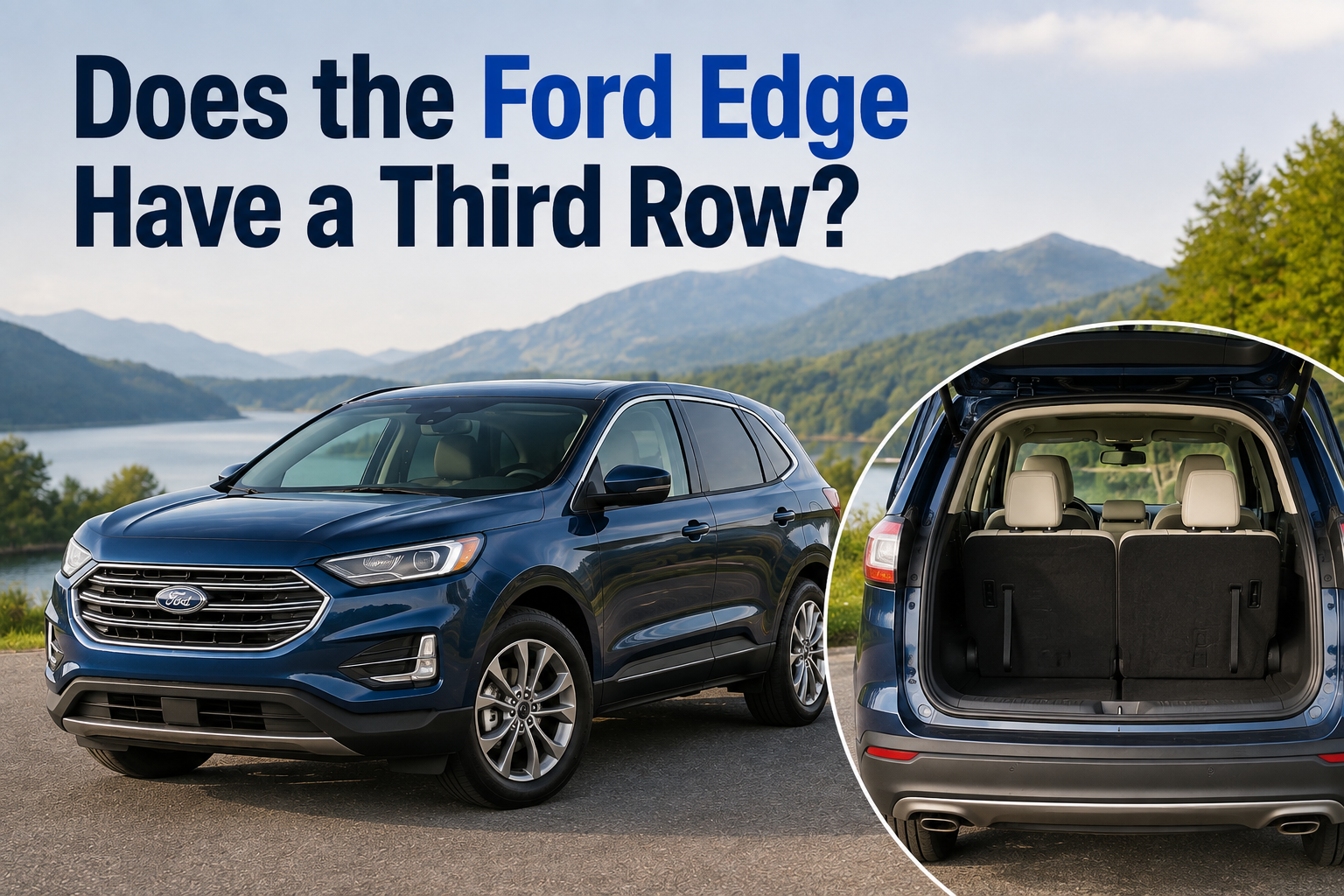
The Edge seats five across two rows. Up front are two bucket seats for the driver and front passenger. The second row is a bench that holds three, though it is most comfortable with two adults or three kids across. That is the whole picture: two rows, five belts, no more.
Where the Edge shines is the space within those two rows. The second row offers roughly 40 inches of legroom and similar headroom, which is generous for a midsize SUV and enough for tall adults to sit without hunching. Behind that second row you get around 39 cubic feet of cargo space, and folding the 60/40 split seats flat opens up far more for bikes, luggage, or a big grocery run. The flat floor and wide cabin make it easy to load bulky items.
If you want to confirm the layout on a specific truck, the checks are simple. Open the rear doors and count the seat belts; the Edge has five. Look at the cargo floor, which is flat and simple rather than split with the hinges and deeper wells you see in three-row SUVs that fold seats into the floor. There is no hidden row tucked away back there.
It is worth clearing up a common source of confusion too. The Edge feels large from the driver’s seat, and it sits close in size to some three-row SUVs, so shoppers often assume a third row must be an option somewhere in the range. It never was. Across both generations sold here, from the 2007 launch through the final 2024 model year, and including the sportier Edge ST, every single Edge left the factory with two rows and five seats. There is no trim, package, or model year that changes that.
Why Ford made the Edge a two-row SUV
This was a deliberate choice, not a limitation. The Edge sits in the middle of Ford’s SUV lineup, bigger than the compact Escape and smaller than the three-row Explorer. Ford designed it to own the two-row midsize space: enough room for a family of four or five, plenty of cargo room, and a refined on-road feel, without the size and complexity of a people-mover.
Adding a third row is not as simple as dropping in two more seats. It changes seat-belt anchoring, airbag placement, crash-test assumptions, and load limits, and it usually requires a longer body. To fit a third row properly, the Edge would have had to grow and give up the second-row space and cargo room that define it. Ford already had the Explorer for buyers who need seven seats, so the Edge stayed focused on doing the two-row job well.
For a lot of buyers that trade is exactly right. If you rarely carry more than five people, a third row is mostly a folded-down space that eats into your cargo area the rest of the time. The Edge gives that space back to the people and gear you actually carry.
The one exception: the Ford Edge L in China
Here is the detail that trips people up. There is a Ford Edge with three rows, but it is a different vehicle sold only in China, called the Edge L. It is longer, built on a different platform, and offers six or seven seats along with an available hybrid powertrain and a large infotainment screen.
The Edge L is not sold in North America and is not the same vehicle as the Edge that ran here. So if you have seen photos or specs online showing a three-row Ford Edge, that is the Chinese Edge L, not something you can buy at a US or Canadian dealer. For every practical purpose in North America, the Edge is a two-row, five-seat SUV, full stop.
The Edge is now discontinued in North America
One more thing worth knowing if you are shopping. Ford ended North American Edge production in April 2024, and 2024 was the final model year. The Oakville, Ontario plant that built it is being retooled for electric vehicles. Any new Edge you see on a lot now is remaining dealer inventory, not a fresh build, and there is no newer Edge coming to replace it here.
This does not change the seating answer, since every North American Edge ever built was a two-row, five-seat SUV. But it does mean the Edge you buy today, new or used, is the most developed version of a design that had years to work out its bugs, which many used buyers see as a plus. Resale tends to follow a gentle curve rather than a steep drop for a nameplate this well regarded.
Ford SUVs that do have a third row
If you need more than five seats, Ford has you covered with other models. Here is how the lineup stacks up by seating:
| Ford SUV | Rows / seats | Best for |
| Escape | 2 rows / 5 | Compact, city-friendly, singles and small families |
| Edge | 2 rows / 5 | Roomy two-row comfort and cargo, five people |
| Explorer | 3 rows / 6–7 | Families needing a third row, occasional 7 seats |
| Expedition | 3 rows / 7–8 | Maximum space, big families, heavy towing |
The Explorer is the natural step up from the Edge for anyone who needs a third row. It is a three-row midsize SUV that seats six or seven, keeps a car-like ride, and still handles daily driving comfortably. For families who need the most space, or who tow heavier trailers, the full-size Expedition seats up to eight and offers far greater towing capability. Both give you the third row the Edge does not.
It helps to know how these differ in daily use. The Explorer’s third row is best thought of as flexible seating: great for kids, fine for adults on shorter trips, and easy to fold flat when you would rather have cargo room. The Expedition’s third row is genuinely roomy enough for adults on longer drives, but the vehicle is much bigger to park and thirstier to run. The Edge slots below both, trading that occasional extra capacity for a smaller footprint and stronger everyday value. Picking between them really comes down to how often you carry a sixth and seventh passenger.
If you loved the Edge specifically for its size and only need extra seats once in a while, it is worth deciding honestly how often that happens. Count the days in a typical month when you actually carry more than five people. If it is rare, a two-row Edge plus an occasional second vehicle or rental may serve you better than living with a folded-up third row every day. If it is regular, step up to the Explorer.
Making a two-row Edge work for a busy family
Plenty of families run happily with a two-row SUV. A few things help:
- Use the wide, flat second row for three across when needed. It handles three child seats or a mix of kids better than many rivals thanks to its width.
- Fold the 60/40 seats to flex between people and cargo. Carry four with a huge cargo hold, or five with a normal one.
- Add a hitch-mounted cargo carrier or roof box for road trips, which frees up interior space without needing a bigger vehicle.
- Plan the rare big-group day around a second car or a short rental, rather than buying a three-row SUV you will drive half-empty the rest of the year.
So, does the Ford Edge have a third row? No. It is a two-row SUV built to seat five in comfort, with the cargo room to match. If that fits your life, the Edge is a roomy, refined choice. If you need six or seven seats, look at the Explorer or Expedition, which are built for exactly that.
Frequently asked questions
How many seats does the Ford Edge have?
Five, across two rows. Two front bucket seats and a three-person second-row bench. There is no third row on any North American Edge.
Is there a three-row Ford Edge?
Only in China, as the separate Edge L, which is a longer, different vehicle with six or seven seats. The Edge sold in North America has always been a two-row, five-seat SUV.
Which Ford SUV should I get if I need a third row?
The Explorer is the closest step up from the Edge, seating six or seven across three rows. For maximum space and towing, the full-size Expedition seats up to eight.
Is the Ford Edge still being made?
Not for North America. Ford ended production in April 2024, making 2024 the final model year. New units on lots are leftover inventory, and the plant is being retooled for electric vehicles.
Can a third row be added to a Ford Edge?
No. A third row affects seat-belt anchoring, airbags, crash safety, and load limits, so it is not something that can be safely added aftermarket. If you need the seats, choose a vehicle built with them.
Related Articles
What Warranty Does a Ford Escape Hybrid Have?
Did Ford Discontinue the Edge? Reasons & Alternatives Explained