




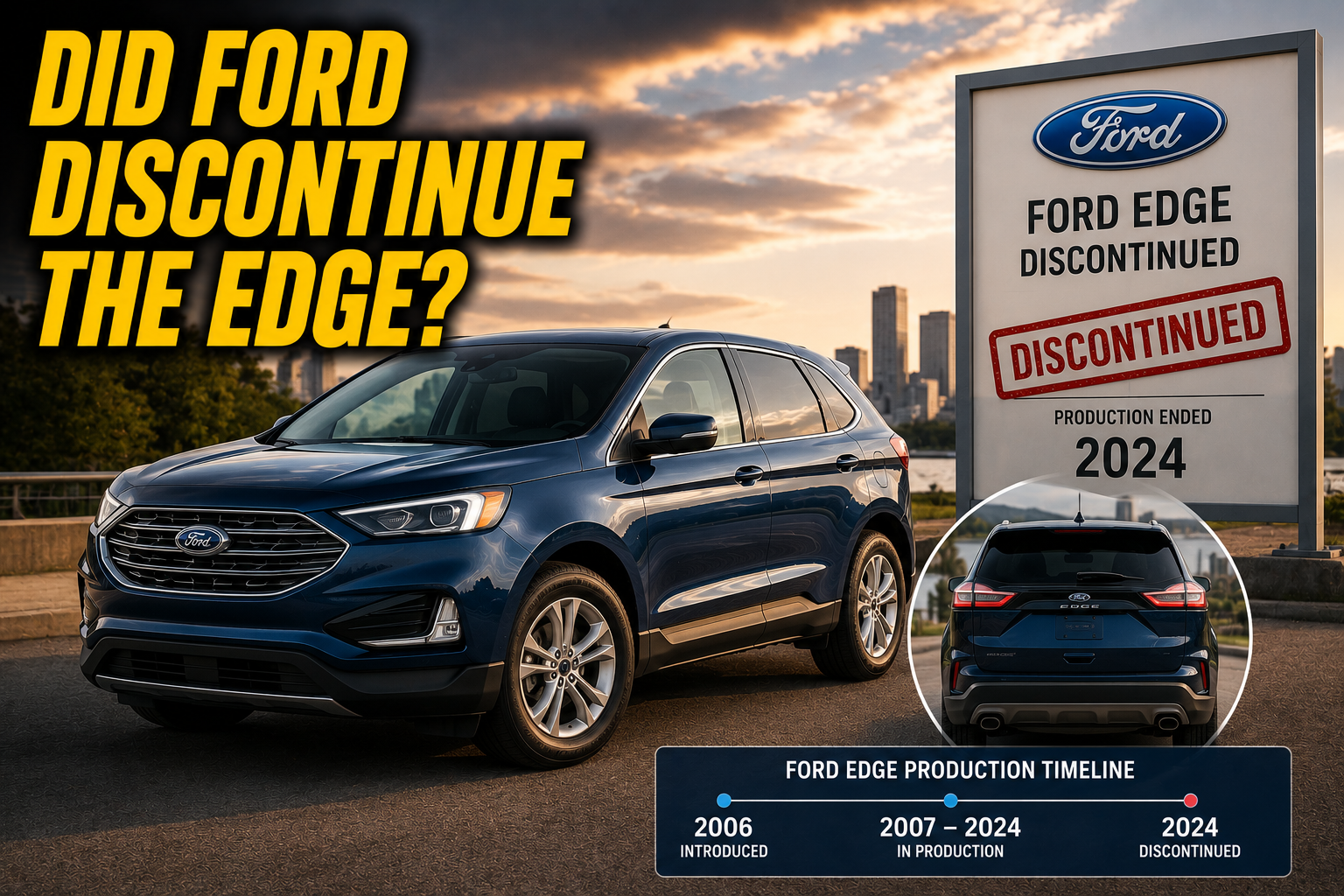
Yes, Ford discontinued the Edge, and production officially came to a close after the 2024 model year. This midsize SUV had been a steady part of Ford’s lineup since 2007, sitting comfortably between the smaller Escape and the larger Explorer.
However, changing market demands, declining sales figures, and Ford’s growing focus on electric vehicles all played a role in this decision. In the sections below, you will find a complete breakdown of the Edge’s history, the exact reasons behind its discontinuation, and what Ford customers can consider instead.
A Brief History of the Ford Edge
The Ford Edge was introduced in 2007 as a midsize crossover designed to bridge the gap between two of Ford’s popular SUVs. Over nearly two decades, it went through two full generations, each bringing noticeable improvements in design, technology, and performance.
Launch Year and Original Positioning (2007)
When the Edge first launched, Ford intended it to fill a specific gap in its SUV lineup. Buyers who found the Escape too small but the Explorer too large finally had a comfortable middle option.
The Edge quickly gained a reputation for offering a smooth ride, spacious cabin, and a more car-like driving feel compared to traditional SUVs of that era.
First Generation Overview (2007–2014)
During its first generation, the Edge focused on comfort and practicality rather than aggressive styling or high performance. It featured a simple yet functional interior, decent cargo space, and engine options that balanced fuel efficiency with everyday usability.
This generation helped establish the Edge as a dependable family vehicle rather than a flashy performance SUV.
Second Generation Redesign (2015–2024)
The second generation, which arrived in 2015, brought a more modern design language, upgraded technology features, and improved safety systems. Ford also introduced turbocharged engine options during this period, giving the Edge a noticeable boost in both power and efficiency. This generation lasted almost a decade and represented the final chapter of the Edge before its discontinuation.
The Ford Edge ST Performance Variant
For buyers who wanted something sportier, Ford introduced the Edge ST. This version came with a twin-turbocharged V6 engine that delivered significantly more horsepower and torque than the standard trims.
The ST trim gave the Edge a performance-oriented identity, appealing to drivers who wanted SUV practicality without giving up quick acceleration and confident handling.
The Official Discontinuation Timeline
Understanding exactly when and how Ford discontinued the Edge helps clear up a lot of confusion floating around online. The announcement did not happen overnight; it followed a gradual shift in Ford’s manufacturing priorities.
When Ford Announced the Decision
Ford’s plans to phase out the Edge became public knowledge well before actual production ended. Reports connected the decision to broader changes at the Oakville Assembly Plant in Ontario, where the Edge was manufactured.
As electric vehicle plans took shape, it became clear that the Edge’s production line would eventually be repurposed.
Final Production Date (April 2024)
Ford officially stopped building the Edge in April 2024. This marked the true end of the nameplate in the North American market, closing out a production run that had lasted since 2007. No 2025 model year Edge was ever released, confirming that the discontinuation was permanent rather than a temporary pause.
Last Model Year and Available Trims
The final model year offered buyers five distinct trims to choose from before the Edge exited the lineup completely.
| Trim Level | Engine Option | Notable Features |
| SE | 2.0L Turbo 4-Cylinder | Base trim with essential features |
| SEL | 2.0L Turbo 4-Cylinder | Added comfort and tech upgrades |
| ST-Line | 2.0L Turbo 4-Cylinder | Sportier styling touches |
| Titanium | 2.0L Turbo 4-Cylinder | Premium interior and driver-assist tech |
| ST | 2.7L Twin-Turbo V6 | Highest horsepower and performance focus |
This table shows how Ford structured the final lineup, giving buyers a range of choices from practical family trims to a performance-focused option right up until production ended.
Why Did Ford Discontinue the Edge?
There wasn’t a single reason behind Ford’s decision to end the Edge. Instead, it was a combination of shifting consumer habits, tough competition, and internal manufacturing priorities.
Declining Sales Since 2020
Sales numbers for the Edge began slipping noticeably from 2020 onward. Buyers increasingly gravitated toward larger three-row SUVs or more rugged models, leaving the Edge’s two-row midsize format feeling less appealing.
This steady sales decline made it harder for Ford to justify continued investment in the model.
Increased Competition
The midsize SUV segment became extremely crowded over the years. Competitors like the Chevrolet Blazer and Hyundai Santa Fe offered similar size, comparable pricing, and modern features that made it harder for the Edge to stand out. This intense competition chipped away at the Edge’s market share over time.
Overlap With the Escape and Explorer
One of the most commonly cited reasons for the Edge’s discontinuation is that it never truly distinguished itself between Ford’s own Escape and Explorer models.
Buyers who wanted something smaller often chose the Escape, while those needing more space or third-row seating leaned toward the Explorer, leaving the Edge stuck in an awkward middle position.
Shift Toward Three-Row and Rugged SUVs
Consumer preference moved steadily toward three-row SUVs and rugged, adventure-styled vehicles like the Bronco. The Edge’s two-row layout no longer matched what a large portion of buyers were searching for, making it harder to justify keeping the model in production.
Supply Chain Challenges
Like many automakers during this period, Ford faced ongoing supply chain disruptions that affected production schedules and costs. These challenges added further pressure on models with weaker sales performance, making the Edge an easier target for discontinuation compared to higher-volume vehicles.
Ford’s Electrification Strategy
Beyond declining sales, Ford’s broader push into electric vehicles heavily influenced the decision to discontinue the Edge. The company needed manufacturing space and resources to support its EV ambitions.
Oakville Assembly Plant Retooling
The Oakville Assembly Plant in Ontario, where the Edge was built, is being converted to support electric vehicle production. This retooling process required significant investment and a temporary halt in traditional gas-powered vehicle manufacturing at that facility.
Partnership With Unifor
Ford worked closely with the Canadian union Unifor to restructure the Oakville plant for its EV future. This partnership was central to ensuring a smooth transition while protecting jobs and production capacity at the facility going forward.
Planned EVs Replacing the Edge
Reports suggest that several new electric vehicles are planned to come out of the retooled Oakville plant. While no direct one-to-one replacement for the Edge has been confirmed, these upcoming EVs represent Ford’s answer to the space left behind in its SUV lineup.
How This Fits Into Ford’s Broader EV Roadmap
Ford has been steadily expanding its electric offerings across multiple vehicle segments, including trucks and performance cars. The Edge’s discontinuation fits into this larger pattern of reallocating resources away from slower-selling gas models and toward the company’s long-term electric vehicle strategy.
What Happened to the Manufacturing Plant
The Oakville Assembly Plant’s future was directly tied to the Edge’s production run, making it an important part of this story.
Oakville, Ontario Plant’s Role
For years, the Oakville plant served as the primary production site for the Edge. Once the model’s production ended, the facility needed a new purpose to remain relevant within Ford’s manufacturing network.
Link to the Lincoln Nautilus Discontinuation
The Edge’s discontinuation followed closely behind changes to the Lincoln Nautilus, which was built on a similar platform at the same facility. Production of the Nautilus shifted to China, further reducing the plant’s workload and accelerating plans for its EV conversion.
Future of the Plant Post-Edge
Industry analysts have pointed out that without a new program to replace the Edge, the Oakville plant’s long-term future depended heavily on Ford’s EV plans moving forward. The retooling effort is expected to secure the plant’s role in Ford’s electric vehicle production for years to come.
Is the Edge Available Anywhere?
While the Edge disappeared from North American showrooms, it hasn’t vanished from the global market entirely.
The Ford Edge L in China
Ford continues to sell a version called the Edge L in China, developed specifically for that market. This model was built locally through Ford’s partnership with Changan and offers features tailored to Chinese consumer preferences.
Differences Between the North American Edge and Edge L
The Edge L includes design and feature updates not found on the original North American version, including an available third-row seating configuration and hybrid powertrain options. This makes it a distinct vehicle rather than a simple continuation of the older model.
Why It Isn’t Sold in the U.S. or Canada
Ford has not indicated any plans to bring the Edge L to North America. The vehicle was designed with a different market’s preferences in mind, and Ford’s current North American strategy remains focused on its existing SUV lineup alongside upcoming electric models.
Alternatives for Former Edge Buyers
For buyers who liked what the Edge offered, Ford still has several strong options available across different segments.
- Ford Escape: A smaller, more fuel-efficient crossover for buyers who don’t need as much interior space.
- Ford Explorer: A three-row SUV offering more passenger and cargo room for larger families.
- Ford Bronco: A rugged, adventure-focused SUV for buyers wanting off-road capability.
- Ford Mustang Mach-E: An all-electric crossover for those interested in making the switch to EV ownership.
Each of these models fills a slightly different need, giving former Edge owners a reasonable path forward depending on their priorities around space, efficiency, or performance.
How Competitors Are Positioned Now
With the Edge gone, competitors like the Chevrolet Blazer, Hyundai Santa Fe, and Honda Passport have more room to attract midsize SUV buyers.
These models continue to offer two-row layouts similar to what the Edge once provided, making them natural alternatives for shoppers who specifically preferred that size class over Ford’s remaining lineup.
Frequently Asked Questions
Will Ford bring back the Edge?
There are currently no announced plans to revive the Edge nameplate in North America, as Ford’s manufacturing focus has shifted toward electric vehicles at the plant that once built it.
What replaces the Edge in Ford’s lineup?
No direct replacement has been officially named, though upcoming electric SUVs from the Oakville plant are expected to fill part of that gap over time.
Can I still buy a new or used Edge?
New Edge models are no longer available in North America, but used models remain widely available through dealerships and private sellers.
Conclusion
So, did Ford discontinue the Edge? Yes, production ended after the 2024 model year, driven by a mix of declining sales, tough competition, and Ford’s strategic shift toward electric vehicles. While the Edge nameplate lives on in China through the Edge L, North American buyers now have to look toward the Escape, Explorer, Bronco, or Mustang Mach-E to find their next Ford SUV.
Related Articles
How Much Can a Ford Maverick Tow?
Did Ford Buy Ferrari? The Real Story Behind the Failed 1963 Deal
What Is the Ford Tremor Package? Complete Off-Road Guide
What Is Ford Co-Pilot360? Complete Guide to Ford’s Safety Suite