

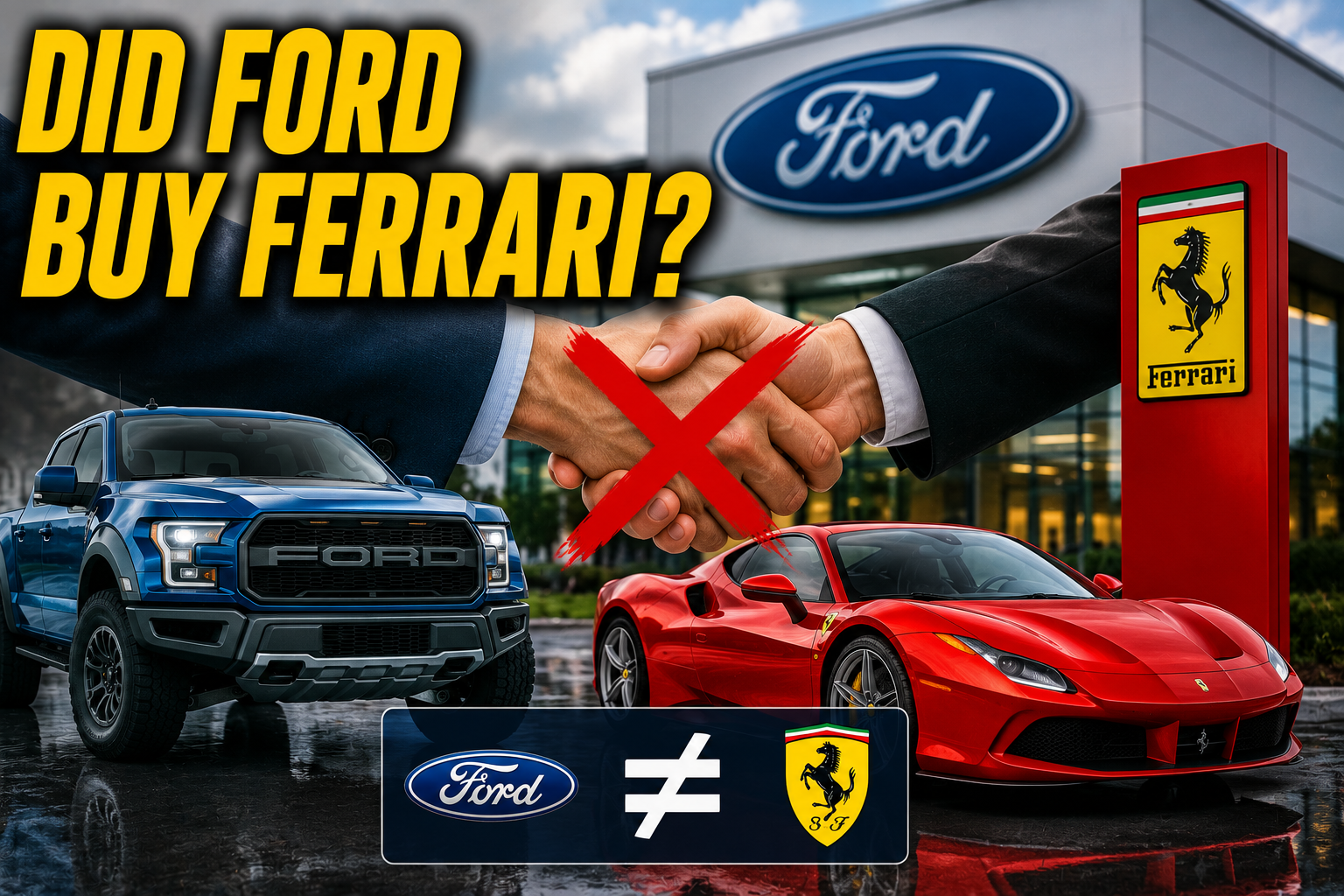
No, Ford never bought Ferrari. Back in 1963, Ford Motor Company came very close to acquiring Ferrari, and both sides spent months negotiating the terms of the deal. However, the agreement fell apart at the final stage because Enzo Ferrari refused to give up control of his racing team.
This single disagreement changed the direction of both companies and eventually led to one of the biggest rivalries in motorsport history. The question “did Ford buy Ferrari” still comes up often because the story is dramatic, surprising, and full of ego, pride, and business politics.
Why Ford Wanted Ferrari
In the early 1960s, Ford had a reputation for building safe, practical, and somewhat boring family cars. Henry Ford II wanted to change that image and attract a younger, more exciting customer base. Buying Ferrari seemed like the perfect shortcut to instant racing glory and a fresh brand identity.
Ford’s Image Problem
Ford was known mainly for reliable sedans and trucks, not performance machines. Young buyers in the 1960s were drawn to speed, style, and racing success. Ford’s leadership realized that without a strong motorsport presence, the company risked losing relevance in a rapidly changing market.
The Appeal of Instant Racing Prestige
Building a racing program from scratch takes years of investment and engineering research. Ferrari already had that legacy, dominating Formula 1 and winning Le Mans multiple times. Acquiring Ferrari would have handed Ford immediate credibility in the racing world without starting from zero.
Ferrari’s Situation in 1963
While Ferrari was a racing legend, the company itself was financially unstable during this period. Enzo Ferrari produced very few road cars each year, and the money from racing alone wasn’t enough to keep operations running smoothly. This financial pressure made Enzo open to outside investment, including offers from a company as large as Ford.
Small Production, Big Financial Strain
Ferrari built only a small number of road cars annually, unlike large manufacturers producing thousands of vehicles. This low volume limited profit and made it difficult to fund expensive racing programs. Enzo needed a financial partner who could support his racing ambitions without draining his resources.
Why Enzo Considered Selling
Enzo Ferrari cared more about racing success than building road cars for profit. Selling a portion of the company to a wealthy partner like Ford could have solved his cash flow problems instantly. However, his priority was always maintaining creative and operational control over the racing side of the business.
The Ford-Ferrari Negotiations
Ford sent a team of executives, lawyers, and accountants to Italy to study Ferrari’s operations in detail. The talks progressed for months, and both companies invested serious time and money into making the acquisition work. At one point, the deal was reportedly just days away from being finalized.
How the Deal Was Structured
Ford proposed splitting Ferrari into two divisions: one for road cars, fully owned by Ford, and one for racing, where Ferrari would retain some involvement. Ford would supply the capital, manufacturing power, and marketing muscle. Ferrari would contribute its engineering talent, racing pedigree, and brand image.
Due Diligence and Legal Review
Ford’s team spent weeks reviewing Ferrari’s finances, factories, and operational structure before moving forward. This process is completely normal for major acquisitions and helps the buyer detect any hidden risks. Everything appeared to be moving smoothly until the discussion shifted toward racing control.
Why the Ford-Ferrari Deal Collapsed
The entire deal fell apart because of one major disagreement: control over the racing division’s budget and decisions. Enzo Ferrari wanted full independence to run his racing team exactly how he wanted, without needing approval from Ford executives.
When Ford refused to give up that oversight, Enzo walked away from the negotiation table completely.
The Racing Control Dispute
Ford insisted on reviewing and approving major racing decisions, including which events Ferrari could enter. Enzo Ferrari saw this as unacceptable interference in the part of the business he valued most. He believed racing decisions should remain entirely under his personal authority.
Enzo Ferrari Walks Away
When Ford specifically mentioned wanting a say in Ferrari’s participation at the Indianapolis 500, Enzo reportedly became furious. He viewed this as proof that Ford didn’t understand or respect the racing culture Ferrari had built. Enzo ended the discussions on the spot, and the acquisition was officially dead.
Ford’s Response: Building the GT40
Henry Ford II was reportedly humiliated by how the negotiations ended and wanted revenge in the most direct way possible. Instead of buying Ferrari, Ford decided to build a car capable of beating Ferrari on the world’s biggest racing stage. This decision led directly to the creation of the Ford GT40.
Recruiting Talent for the Project
Ford brought in experienced figures like Carroll Shelby to help design and develop a competitive endurance racer.
The goal was clear from day one: defeat Ferrari at Le Mans, the race Ferrari had dominated for years. This project became one of the most expensive and determined engineering efforts in Ford’s history.
Early Struggles With the GT40
The first GT40 models faced reliability problems and failed to finish several early races, including Le Mans in 1964 and 1965. These setbacks were frustrating, but Ford refused to abandon the project. Continuous testing and redesigns eventually turned the GT40 into a serious competitor.
The GT40 Defeats Ferrari at Le Mans
In 1966, Ford’s persistence finally paid off in dramatic fashion at the 24 Hours of Le Mans. The Ford GT40 achieved a historic 1-2-3 finish, ending Ferrari’s long streak of dominance at the event. This moment became one of the most celebrated achievements in American motorsport history.
The Historic 1966 Victory
Ford’s three GT40 cars crossed the finish line together, delivering a symbolic and complete defeat of Ferrari. This win proved that Ford’s investment in racing technology had finally matched, and even surpassed, Ferrari’s engineering excellence. It remains one of the most talked-about finishes in Le Mans history.
Continued Dominance Through 1969
Ford didn’t stop after one win, going on to claim victory at Le Mans for four consecutive years. This sustained success cemented Ford’s reputation as a serious performance and racing brand. The GT40 legacy still influences Ford’s approach to performance vehicles today.
What Happened to Ferrari Afterward
After rejecting Ford, Enzo Ferrari eventually needed financial support again later in the decade. In 1969, he agreed to a partnership with Fiat, another Italian company, under very different terms than Ford had offered.
The Fiat Partnership
Fiat purchased a significant stake in Ferrari but allowed Enzo to retain control over the racing division. This arrangement gave Ferrari the financial stability it needed while respecting Enzo’s most important condition. It succeeded where the Ford negotiation had failed.
Ferrari’s Independence Today
Ferrari eventually became part of the larger Stellantis group through its connection with Fiat over the decades. Despite these ownership changes, Ferrari has always maintained a strong identity separate from its parent companies. This independence traces back directly to Enzo’s insistence on protecting racing control.
Ford v Ferrari: Fact vs Movie
The 2019 film “Ford v Ferrari” introduced this story to a much wider audience, focusing heavily on the Le Mans rivalry. While the movie captures the emotional core of the story accurately, some scenes and timelines were adjusted for dramatic effect.
What the Movie Got Right
The film accurately portrays Ford’s failed attempt to acquire Ferrari and the resulting rivalry between the two brands. It also correctly highlights Carroll Shelby’s central role in developing the GT40 racing program. The tension between corporate interests and racing passion is depicted realistically.
What Was Dramatized
Certain characters, conversations, and side plots were fictionalized or exaggerated for entertainment purposes. Real business negotiations rarely include the exact dramatic confrontations shown on screen. Viewers should treat the movie as inspired by true events rather than a documentary.
Comparing Ford and Ferrari’s Approach
| Aspect | Ford | Ferrari |
| Business Focus | Mass-market vehicles | Exclusive performance cars |
| Racing Priority | Marketing and brand image | Passion and personal legacy |
| Control Style | Corporate oversight | Founder-led independence |
| Outcome After 1963 | Built GT40, won Le Mans | Partnered with Fiat instead |
This comparison shows why the original deal was doomed from the start. Ford operated like a large corporation focused on structure and oversight, while Ferrari operated like a passionate racing house built around one man’s vision.
Conclusion
So, did Ford buy Ferrari? No, and the reason comes down to a single unresolved issue: control over racing decisions.
Ford wanted oversight, Enzo Ferrari wanted independence, and neither side was willing to compromise. This failed deal accidentally created one of racing’s greatest rivalries and led directly to Ford’s historic Le Mans victories.
Frequently Asked Questions
Did Ford ever own any part of Ferrari?
No, Ford never gained any ownership stake in Ferrari at any point.
Who owns Ferrari today?
Ferrari operates independently but has historical financial ties to Fiat and Stellantis.
Was the GT40 built specifically to beat Ferrari?
Yes, Ford created the GT40 mainly to defeat Ferrari at Le Mans after the failed deal.
Is the movie “Ford v Ferrari” historically accurate?
It’s mostly accurate but includes dramatized scenes for entertainment purposes.
Related Articles
What Is the Ford Tremor Package? Complete Off-Road Guide
What Is Ford Co-Pilot360? Complete Guide to Ford’s Safety Suite
Is The Ford Escape A Good Vehicle? Full Honest Review 2026
How Long Do Ford Escapes Last? Complete Lifespan, Mileage & Reliability Guide